"Many practitioners of ecological art use walking as
a strategy to either engage audiences or to research a site. It is an
attractive methodology because it is simple, economical and heuristically inclusive.
Richard Long, a British walking artist, whose practice began in 1967 with an
iconic work, “A line made by walking,” in which he traced and retraced his
steps until he had worn a line in the grass field, close to London, is often
cited by other artists as an inspiration to their practice, that often includes
references to sound. Long has referenced the importance of listening and
hearing during his walks. On his website, part of his statement refers to, “The music of stones.” - excerpt from the third chapter of my dissertation 2013
When I was 11, I walked for hours in the woods near my home, not far from the Hudson River, every afternoon, after school, with my dog, in all seasons. I was trying to learn to walk soundlessly on dead leaves, as I imagined Hiawatha might. Sound has a taste, a smell, a tactile quality on the skin. Each season the leaves had a different sound when I failed to be soundless. Crackly in the Fall, soft in winter, tiny in Spring, warm in Summer.
When I was 18, every morning en route to Parsons School of Design, in four inch heels, I walked from Grand Central Station to my first class, practicing what I learned in Joseph Pilates Studio, moving thru the crowds swiftly, smoothly but balanced, aware of each detail of my environment and synchronizing every part of my body without any extraneous movement, breathing deeply and rhythmically. I didn't know that was a performance.
When I was twenty-two, directing my own street theatre group, the American Ritual Theatre, I watched my dancers move slowly, deliberately through Eucalyptus trees on a far ridge East of San Diego that was still undeveloped country, passing between the pale trunks like fluid vertical ghosts between pylons. That was a performance without an audience. Another time, dressed all in silver and wearing silver body paint, we walked slowly thru the streets of the city of San Diego.
From 1990-2000, I walked the paths of the Trigger Point Garden in the Ghost Nets restoration, learning the sounds of each microhabitat as it gathered entropy and adapted to itself.
When I walked the same paths yesterday morning, with my sister, we remembered what the site looked like when I began: a plant here and there on barren slopes while we passed beneath boughs of spruce and dogwood and heard the distant sound of the tide. In the sound of the tide, I imagined fish swimming.
In my mind, as my pages dissertation add up, I walk the Wolf River, from the Ghost River to the Mississippi river, hearing the unfamiliar sounds I recall from May in Memphis and marking in my mind, "here," "here," and "here." Here, would be trigger points to intervene and reconnect the broken pieces of habitat. There, I would hear fish swimming upstream.

Showing posts with label Ghost River. Show all posts
Showing posts with label Ghost River. Show all posts
Saturday, July 20, 2013

Saturday, April 13, 2013
Twenty-one days to Memphis- how are the Magnolia blossoms doing?
 |
| The resilience of Magnolia blossoms has been undeterred by the vagaries of climate change in New York City. |
The premise of trigger point theory (my dissertation topic), is that it is possible to identify small points of blockage, like acupuncture points on a human body, where activating that blockage can yield to energetic flow. My goal in Memphis next month is to identify those points.
There are twenty one days till Fish Story begins in Memphis. A Rockethub crowd funding campaign was launched last week to support this work. I am working on a press release. I am exhausted, excited, worried and optimistic. I am exhausted by the preparations, excited about the potential, worried about everything that could go wrong and optimistic about what lies ahead: the people, the opportunities, the learning.
The Fish Story team is remarkable, particularly the two scientists I work with. Dr. James White, paleoecologist and Dr. Eugene Turner, a wetlands biologist.
Fish Story is an investigative experiment couched in an endurance performance.
May 4, Dr. Turner and I will canoe the pristine Ghost River, headlands of the Wolf River, a former tributary of the Mississippi River, with the Wolf River Conservancy. We will be photographing fish habitat along the way.
May 7, we will gather at Crosstown Arts (see April 11 Post) with high school students. Our goal will be to create some maps of relationships between what is known and what is felt about connections between the waterways that fish depend upon. I will explain the ideas. We will play the Anthropocene Game (see January 23 Post). I ask people to sit, relax, close their eyes and let me sing to them, acapela in French, Faure's "Au Bord de L'Eau." Then we will make maps of what we know about fish in Memphis.
May 7-10, I will install work from those experiences at the Memphis College of Art.
May 11, we will project a webcast in the installation room at the College, to compare different parts of the country and possibly the world and the issues they are facing about climate change, animal habitat, particularly for fish and the implications for humans.
A month ago, I began training for these events. I have continued to move ahead with my dissertation writing, clarifying the ideas I will bring to the table there. I have stepped up my singing lessons and my voice is in better shape. Today I recorded the Faure song for the event at Crosstown Arts, even tho I plan to sing live. I have been going to the gym to build my strength and stamina. Several times I've collapsed from the effort and half way thru, hurt my foot by inflaming osetoarthritis. I just can't whip myself into shape the way I might have even twenty years ago. I soldier on and get stronger. I have always considered my Chronic Fatigue Syndrome (CFS see January 12 and March 1 Posts) to be a useful metaphor for the issues the planet faces under the duress of the Anthropocene. That is, if we can't continue to function as a healthy systems so we must discover how an unhealthy system builds resilience despite continued stressors, and thrive.
A recent article on the resilience of collapsing systems, indicated that the rate of recovery for fragile systems can be enhanced by proximity to healthier systems. In other words, if one system fails, be sure to reinforce a neighbor. So in Memphis, we will start with the healthiest section, the Ghost River. In New York City, the days when I can't rain or even sing, I think. When my reserves build back up, I venture out, nourish myself with the exquisite spring unfurling of magnolia blossoms and resume the training that will prepare me for the lessons Memphis has to teach us.
May 4, Dr. Turner and I will canoe the pristine Ghost River, headlands of the Wolf River, a former tributary of the Mississippi River, with the Wolf River Conservancy. We will be photographing fish habitat along the way.
May 7, we will gather at Crosstown Arts (see April 11 Post) with high school students. Our goal will be to create some maps of relationships between what is known and what is felt about connections between the waterways that fish depend upon. I will explain the ideas. We will play the Anthropocene Game (see January 23 Post). I ask people to sit, relax, close their eyes and let me sing to them, acapela in French, Faure's "Au Bord de L'Eau." Then we will make maps of what we know about fish in Memphis.
May 7-10, I will install work from those experiences at the Memphis College of Art.
May 11, we will project a webcast in the installation room at the College, to compare different parts of the country and possibly the world and the issues they are facing about climate change, animal habitat, particularly for fish and the implications for humans.
A month ago, I began training for these events. I have continued to move ahead with my dissertation writing, clarifying the ideas I will bring to the table there. I have stepped up my singing lessons and my voice is in better shape. Today I recorded the Faure song for the event at Crosstown Arts, even tho I plan to sing live. I have been going to the gym to build my strength and stamina. Several times I've collapsed from the effort and half way thru, hurt my foot by inflaming osetoarthritis. I just can't whip myself into shape the way I might have even twenty years ago. I soldier on and get stronger. I have always considered my Chronic Fatigue Syndrome (CFS see January 12 and March 1 Posts) to be a useful metaphor for the issues the planet faces under the duress of the Anthropocene. That is, if we can't continue to function as a healthy systems so we must discover how an unhealthy system builds resilience despite continued stressors, and thrive.
A recent article on the resilience of collapsing systems, indicated that the rate of recovery for fragile systems can be enhanced by proximity to healthier systems. In other words, if one system fails, be sure to reinforce a neighbor. So in Memphis, we will start with the healthiest section, the Ghost River. In New York City, the days when I can't rain or even sing, I think. When my reserves build back up, I venture out, nourish myself with the exquisite spring unfurling of magnolia blossoms and resume the training that will prepare me for the lessons Memphis has to teach us.
 |
| Senselessly, in the face of so much to be healed, came news of the bombings in Boston at the marathon finish line. But no matter what, the promise of spring is that hope cannot be denied. |
Sunday, December 16, 2012
Day 4, December 16, 2012 Preparation for Fish Story, Memphis, TN
The pictures I took on my last day in Memphis, preparing for May's "Memphis Social," were all about the trajectory of fish and water from one small tributary (the Ghost River) to the Mississippi, via the Wolf River. It is a path fraught with human infrastructural impediments to the free flow of clean water and that trajectory recapitulates many obstacles to either sustainability or resilience humans have instituted. Those obstacles often mitigate against our own survival and recapitulate questions about environmental justice and ecoregional linkage.
One of those obstacles is what may be contaminating the water. Most countries are now dealing with the "choice" between fracking for natural gas and the "environment," framed as choices about energy vs. water and air quality. But is energy all there is?
In TN, yesterday, where I spent most of the day researching for Fish Story, I drove thru healthy farmland. TN is not far from fracking activity in North Dakota. North Dakota is where TN water comes from and the TN dilemma is a paradigm for the rest of the world. Fracking is already an issue in Pennsylvania & an imminent issue for New York State. The UK is teetering on the brink of enormous decisions about fracking and much of Europe has taken sides on the controversy.
This recent article by Elizabeth Royte in The Nation, details the additional implications of potential impacts on food supplies:
http://www.thenation.com/article/171504/fracking-our-food-supply#


I drove to the Ghost River and back before heading to the airport. The trajectory from Ghost River to the Mississippi via Wolf River will be the heart of my plan for the Fish Story events in May for Memphis Social.
I won't go into the insanity of trading not just water or wildlife but food for the short term energy "benefits" of "natural" gas. But consider: Royte writes of the tails dropping off of cattle and squirrels. There is currently no testing being done on animals and plants subjected to nearby fracking. We have no tails that might fall off when we consume our food. But as apex predators, the chances are that our bodies will concentrate even more toxins that will affect our systems.
In speaking with some of the Foundations in Memphis, Ducks Unlimited, a representative said, "we are moving as fast as we can slowly." The problem for us all, is that may not be fast enuf.
Royte's additional information speaks again, to the often difficult tension I, along with so many others, struggle to sustain, between urgency and calm reflection on challenging environmental issues. The advice from Royte was, ask your organic farmers, 'how close are you to fracking and have you tested your produce?'
Royte's additional information speaks again, to the often difficult tension I, along with so many others, struggle to sustain, between urgency and calm reflection on challenging environmental issues. The advice from Royte was, ask your organic farmers, 'how close are you to fracking and have you tested your produce?'
 |
| Approaching the Church of the River, which has prioritized good stewardship for its' location on the river. |
 |
| The view from the Church of the River onto the Mississippi before the service, just past the point where the Wolf River historically emptied into The Big Muddy. |
 |
| Singing Christmas carols at the Church of the River after the service. |
 |
| The Rev. Burton D. Carey clowning with his congregation, as one of the lords a leapin' for the "12 Days of Christmas," at the Christmas carol sing-a-long at the Church of the River. |
 |
| View of the Mississippi after the Church of the River service and caroling, 2 hours after I first arrived, with a subtle change in the light. |
 |
| Band of erosion exposing the rich soil quality, down a country road near the beginning of the Ghost River that feeds the Wolf River, a tributary of the Mississippi. |

 |
| At the end of the country road I drove down, it turned into a dirt private drive for what was apparently a large estate, possibly a former cotton plantation. |

 |
| Once this countryside was part of King Cotton, the center of the economic world. Now, the remnants of field cotton look just like melting old snow, like another vanishing memory, the real snow of "real" winters, before global warming. The vast cotton industry was sustained with slavery, arguably, analogic to how the present world economy is sustained by fossil fuels including natural gas. |


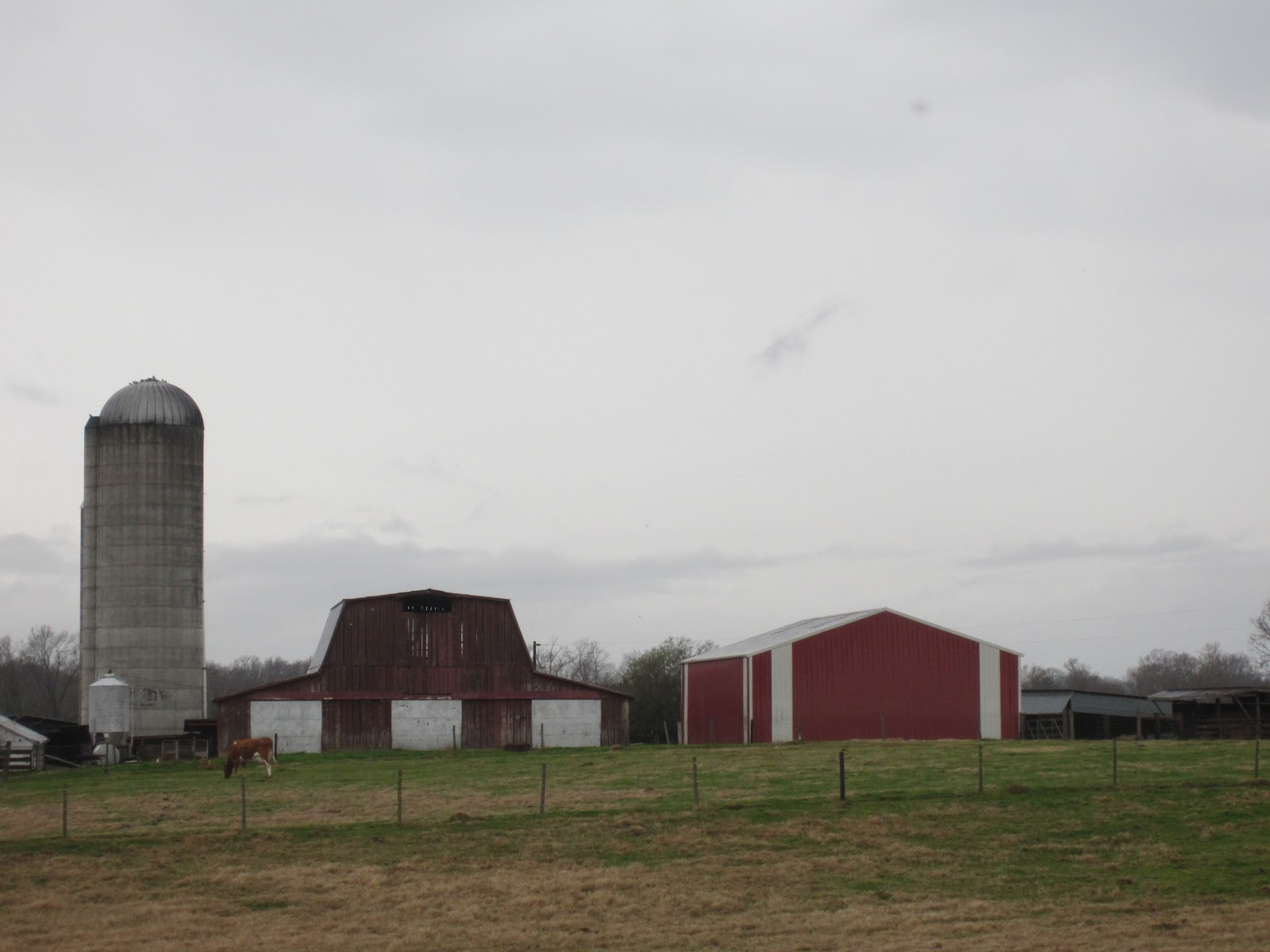 |
| Rural Tennessee is just an hour outside the city, |


I drove to the Ghost River and back before heading to the airport. The trajectory from Ghost River to the Mississippi via Wolf River will be the heart of my plan for the Fish Story events in May for Memphis Social.
Subscribe to:
Posts (Atom)