Showing posts with label Jerry Saltz. Show all posts

Friday, March 22, 2013

Connecting the art market to Fish Story, to the Rockaways, to Memphis in May

Recently, I collaborated with the ecoart collective to send a video proposal to MoMA, on the occasion of their call to "rebuild" the Rockaways waterfront since Hurricane Sandy. http://www.ecoartnetwork.org/wordpress/moma-expo-1-new-york-rockaway/. I believe the same issues facing the Rockaways are facing the fish in Memphis or the art market in NYC. They are all fulcrums. 

The basic response from the ecoart collective was that the very idea of rebuilding the Rockaways waterfront in the anthropocene is an oxymoron. Rather, as the artists Newton and  Helen Harrison have suggested, we need to "withdraw gracefully." The solution I see, isn't always withdrawal. The variations depend on thinking bioregionally and then looking for "trigger points," to effect environmental justice. It always starts, not with the people, but the animals. That is why I keep coming back to fish for Memphis (Fish Story).

On Jerry Saltz's FB page yesterday, Mia Pearlman posted a link to Ed Winckleman's blog decrying the state of the art market today. My response, which I've posted below, was that the art market only reflects the global crisis. To my way of thinking, the ecoart collective's video was a response to that insanity, and for that reason, I would be very pleasantly but nonetheless surprised if MoMA likes it (my implication being that MoMA is the belly of the art market beast). That said, I think the "answer" to the art market/ fish/the anthropocene will be collective. The panel I suggest at the end of this post is specific to the art world but the premises could easily be expanded in the right venue:


Here's the link to Ed's page http://www.edwardwinkleman.com/2013/03/saving-endangered-true-believers.html — with Edward Winkleman. and here is my long-winded response:

I really appreciated this post & thread. I was so dismayed by my art fair experience last weekend that after just one 2 hr stint, I went home & took a long nap. The most interesting work I saw were the women who could walk on ultra-high heels. 

Exhibit A of the NY Art World Fairs


The recommendations (in Ed Winckelman's blog) are great but what I think is happening to the art world precisely mirrors what is happening environmentally and economically: as species (and classes and roles) get hollowed out, connections break and the entire system gets pushed past a threshold point of collapse where it will self-organize.

As an ecological artist, on the one hand, I think it is possible to predict what will precipitate the "last straw" that will create that self-organization. I have been saying for a while, that the best hope is in understanding physics. There is a point (that I call a trigger point when it is deliberately calculated) where Maxwells' "demon information" can displace the old system. I can calculate that environmentally, but the art market in some ways is still less over-simplified than what we see in ecosystems in the anthropocene. The problem I see that needs to be examined, is what are the factors that go into modeling predictively?
I presume, based on thinking about the natural environment, that the greatest factors are neither obvious nor easy to move, such as capitalism run amuck. On the other hand, if my reference to physics is correct, it may just take the right small trigger to effect change.
I can only go back to what I work on in my own practice as a model. 

Right now, I'm experimenting with trying to recapitulate the pressure, multi-tasking and preparation work that will go into solving climate change in a project I'm preparing for May in Memphis (Fish Story). I see that as an endurance performance. The personal trick for me, is how to do that without burning out & crashing before I get there, let alone afterwards.
The relevance of my practice model to the art market is that if the artist is the "trigger point" in the critical shift we all need, the question is how individual artists are going to survive the present? The short answer is not easily and not alone. Artists have been competitively divided from dealers and each other. But no matter how powerful insanity may be in the art world right now, like fracking, there are many more of "us" losing from what is happening than there are of "them" gaining big time at everyone else's expense.  

When Rob Storr recently addressed the College Art Association (CAA) with a litany of what the schools & academia are doing wrong, instead of complaining about how he was a "downer," I think he should have been heard as a clarion call from Cassandra. His talk and some others last month at CAA, this blog and the responses, Jerry's FB page are parts of what keeps me going so I don't crash in isolation as an artist. I believe we can be the 99% if we make ourselves heard. 

The simplest answer to what can be done is to say it more and say it loudly. This is a collective endurance event.

As I was typing this, I got a call from the artist Carolee Schneemann and we talked about where values and discernment had gone these days (out the window). Values & discernment will go the way, I think of this entire world unless those of us who care passionately about a different set of values find our collective voice. That process of finding a collective voice, is, I think the "demon information" that could trigger a change.
Will it bring back a past we loved or at least sentimentally enjoyed in our lifetimes? Not for many polar bears or elephants, not for the people who now have polluted water and not for many of us in one aspect or another of the art world in our lifetimes. But something & some of us will survive with integrity.

My suggestion: put together a panel some place very visible, inc Ed, Jerry, Rob, Carolee, Alain & whomever else has a clear voice (more articulate women) and drag people to it with a media campaign that connects these issues to all the others we are facing globally.
Add Mira Schor and Mierle Ukeles to that panel.

Friday, November 2, 2012

Art, climate change and politics

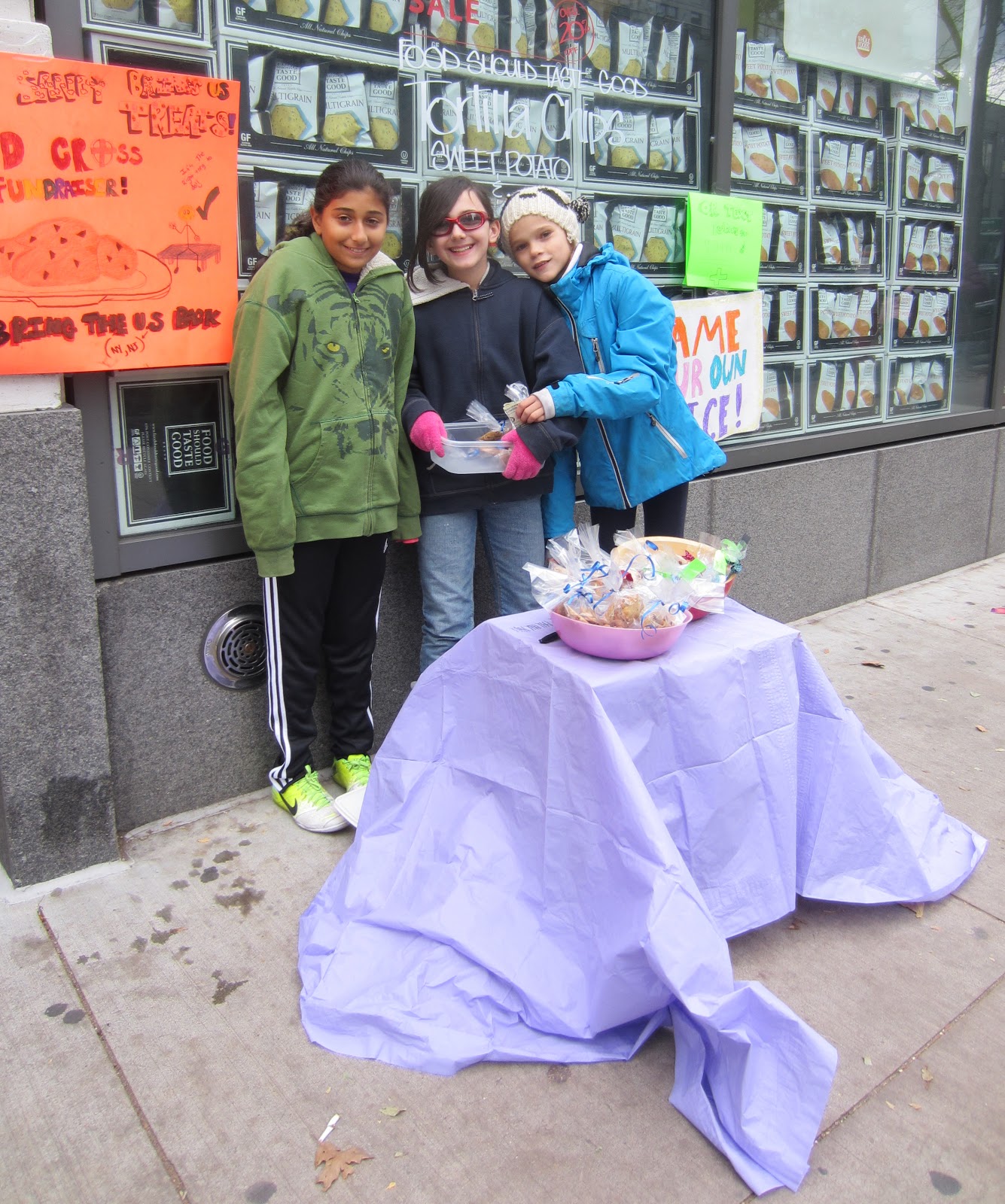
Girls outside the UWS Whole Foods raising $ for the Red Cross by selling homemade cookies. It was nice to give them a dollar and let them keep the cookies instead of my usual dollar to hopeless homeless people.
The coming together of people to support the city they love has been very moving to me

http://www.vulture.com/2012/11/jerry-saltz-devastating-visit-to-chelsea-galleries.html
  • This is an amazing, heart breaking account from Jerry Saltz, of loss and heroism to flank the stories of trying to help the elderly & infirm victims of the Hurricane Sandy disaster or my own posts about the impact on animals, as the fish and birds in the Tri-State region. All martyrs to climate change denial. 
  • Art is like a beating heart that lives outside a body. And now it has become disconnected and trashed. a bunch of those hearts have been ripped from those bodies by the tidal surges and sea level rise of global warming driven by fossil fuel production. I am grateful to Jerry for being one of her caretakers.
  • As he wrote, it's easy for us to knock the gallery system, dealers, etc, But these are our blood kin. I was esp upset about Printed Matter, an institution-cum-museum of alternate art and a real tragedy. 
I woke still haunted by the implications of Jerry's essay. What haunts me is the combination of the cultural impact of climate change and the personal implications of the rise of the right. They are inseparable.

In 2009, I was an official observer for the University of Colorado at Boulder, where I am an affiliate, for the United Nations IPCC meetings at the Bella Center in Copenhagen. 
http://www.ipcc.ch/
I blogged about my experiences and observations:

http://www.blogger.com/blogger.g?blogID=3532459556869820195#allposts

The most moving of all the presentations then was from the island nation of Tuvalu http://www.tuvaluislands.com/.

To standing room only, they held a session about the loss of their homeland to sea level rise, with flowers, dancing, song, giving us all necklaces and impassioned pleas to hold the island nations in mind as we discussed climate change.

There was a lot going on then, but one of the actions I was involved with was an ethical action group, led by Don Brown http://blogs.law.widener.edu/climate/ who had worked on toxic waste sites in the Clinton administration. We crafted the press releases for the press conference and one of the points I focused on was language in the IPCC documents to the effect that we must protect the cultural treasure of impacted nations, such as Tuvalu, as much as we concern ourselves with economic sustainability. I vividly recall crafting phrases for that press release, to the effect that culture is what holds a people together and allows them to be resilient.

I had been scheduled to give our own press conference, on the work Jim & I were doing as a precursor to Fish Story: "Gulf to Gulf," when the police cordoned off the Bella Center and began beating demonstrators in the City of Copenhagen. That was followed in swift reprisal, by a flood of corporate funding to seed global doubt over global warming, drown out the island nations and scientists and culminating with the present Citizens United decision which has allowed one party to, in effect, precipitate a corporate take over coup of the United States.

Previously, in work with Jim White, of INSTAAR who enabled my attendance at the iPCC, we had spoken about our horror over, and generated visuals from, studying the projected global impacts of climate change refugee migrations. Our horror was over the human cost.

Most of the attention to the impact of of Hurricane Sandy in NYC has gone to Wall St and transportation to get back to work and return to normal life. What people are missing is that this is the new normal. NYC is also an island "nation" in the same peril, with the same implications as the fate of Tuvalu. And NYC is the canary, singing for all she is worth about the peril we all face. Jerry is a good microphone for that song.


Thursday, October 11, 2012

Courage, lies and the art of the horizontal conference in our brave new world


The brave new world of "Fish Story" in Memphis, TN

This evening, I'm heading to a reception for the weekend Creative Time (CT) conference instead of listening to the Ryan- Biden debate. I expect it will help me think about my new project, "Fish Story." 

There is a lot of talk in the circles I'm in about Romney as a liar. Sean Capone, for example, on Jerry Saltz' FB page, has taken on a Republican at great length for the past couple days, itemizing not just Romney's lies, but how even Newt Gingrich was confounded by how to debate with a bald-faced liar. Here's Clinton on Romney's performance: 


What is the evil power of a lie? I think the reason people lie is fear. Compare the trajectory that the radical right that Romney & Ryan represent, to the Taliban in Pakistan who tried to murder Malala Yousafzaia for being progressive, bright and wanting an education. 

http://www.nytimes.com/2012/10/10/world/asia/teen-school-activist-malala-yousafzai-survives-hit-by-pakistani-taliban.html?smid=fb-share

They are all afraid. And they are willing to lie to themselves as well as others rather than be courageous about scary realities. Every bully is someone who is scared inside, scared by their own fear. I think what these people are scared of is our present. I think any reasonable person is scared of our present, where nuclear weapons could fall into the hands of crazies, where corporations have taken over global governance, where new, essential expensive tech toys come out every week, our food is tainted, our waters are disappearing under the weight of over-population and fracking, and climate change, cross-dressing and uppity women are the new norm.

We are all scared by and initially inadequate to change. But when terrifying people who are so terrified of real life, that they act on their yearning for a delusionally unchanging world where they might feel safe, secure and in control, are willing to murder, debase, destroy whatever stands in their way to go back to that imagined Eden, that's when they endanger themselves and their own children as much as they threaten the rest of us.

My take on the people who would have murdered Malala is that they are like the Neo-Nazis around the world or the retro bullies in the USA, who egg on Romney and cheer for Ryan when they declare on the stump that they will cut access to good public education, social services for the poor and deport immigrants. 

The right, whether in the USA or Pakistan, seems to confuse economic prudence with depriving the future of the tools to think clearly. In the case of the USA and Europe scarcity as replaced planning. In too many places, gender freedom is threatened by those who can't accept difference. I have to label this cowardice about the dangerous present and the scary future. The cowards are those who want to return to an imagined past, running from what we all fear rather than facing the present and difficult options. 


Since 2009, the corporate right seems to have figured out that they need to fight back and have responded on the same horizontal globalized level, countering a grass roots movement with big oil money, seeding sufficient doubt, particularly in the USA, where leadership on climate change is so critical, to arrest critical change and dig in with ever-more aggressive extractive fossil fuel industries and repressive social policies.

Just saying no to the present isn't an option. We must parse real options to survive. Real options include understanding the history of the kinds of choices we need to make, socially, economically and environmentally. That is an interdisciplinary process.

I've been going to interdisciplinary conferences since the early nineties. Many artists, including myself, are used to the College Art Association conferences, where thousands of artists compete for attention to get jobs. But in the early nineties, I started attending and presenting at science conferences, starting with the Island Institute and the Society for Ecological Restoration. And then in 2009, I was at the IPCC conference on climate change in Copenhagen and realized that for that historical moment, the whole world became what I labeled a "horizontal conference," and wrote about for James Brady in the UK and the Center for Sustainable Practice in the Arts (CSPA). 


Difficult parsing is why I'm going to a CT art conference tonight. Art is where we think big, broad and courageously- albeit, not fearlessly. Being fearless in the face of real danger is stupid. The reason I'm going to a reception for a conference where I'll see my art colleagues instead of listening to tonight's Vice-presidental debate (which will no doubt will be rerun to my heat's content later), is my faith in the horizontal conference, which is not just about CT. It is in the conversations I read and engage on FB. It is on NPR and even on Rush Limbaugh because Limbaugh is countered on FB and NPR, as is the Taliban and the Republican right. The horizontal conference is something artists are really, really good at. It is, in fact, a discursive performance of democracy.

In this performance, there is no golden man at the center, no superstar, no perfect hero. Yes, of course some people stand out. But at it's best, the horizontal performance of democracy gathers collective intelligence. It is not a mob led by a bully. Artists, as many have pointed out, are as easy to corral and lead as a herd of wet cats. We are too iconoclastic, too broody, too egocentric and self-centered, too freedom loving and rebellious to conform to anything or anyone very easily. And we are very bad liars. These failures are, in fact, the very strengths I suspect we need right now to deal with our very complex, brave new world.

In the next weeks, as the election looms and my thoughts and plans take greater shape, I will write more about applying these skills to "Fish Story," for Memphis, TN and Social Memphis.

http://www.beautifulfields.org/memphis-social-curatorial-statement