Yesterday, Gene Turner, Jim White and myself assessed what we learned from Fish Story in a "Gulf to Gulf" webcast. I will load that in the next week, along with responses to our questionnaire to our audience.
Meanwhile, I am putting finishing touches on an article about the project. On FB, I wrote:
I took time from my diss revisions to rewrite the conclusion of an article coming out in the Journal of Environmental Studies and Sciences (ESAS) on Fish Story:
"In conclusion, we observed that the tributaries are indeed a critical part of the Mississippi water basin puzzle but so are people. Trigger points for change in the Mississippi watershed will require not only the sustained efforts of ecological restoration scientists working on the Wolf River but far more extensive plans for public education about and engagement in restoration. That engagement must include the regional participation of young people who will inherit the mistakes of their elders, particularly from the inner city areas of Memphis. Fish Story was a modest initiative towards accomplishing the long term goal of devising strategic responses to environmental damage in the Anthropocene era. This project provided a beginning to effect the 36% greening White calculated might be imminently required of all human kind. Our experience was that art may play a significant role in changing necessary public paradigms for thinking and behavior. It was an incentive for further research and experimentation to build on lessons learned."

Showing posts with label Wolf River. Show all posts
Showing posts with label Wolf River. Show all posts
Wednesday, October 23, 2013

Wednesday, August 7, 2013
Another painfully sad Fish Story
Earlier today, I was studying a promising report from Shelby Farms Park Conservancy on restoring the bottom lands forests of the Wolf River in Tennessee. Then I saw the following discouraging report, on the heels of another report, of a Polar Bear who had died of starvation because the melting ice flows are now too far away from their food sources. I hope there were at least some Alaskan bears around to feast on this die-off:
 Unusually hot, dry weather in Alaska is wreaking havoc on fisheries, as thousands of fish perish in overheated waters. Last month, 1,100 king salmon died on their way up to the Crystal Lake hatchery due to water temperatures around 80 degrees Fahrenheit and lack of oxygen. That’s the bulk of the 1,800 adult salmon that were expected to return to the hatchery this season.
Earlier in the summer, another hatchery lost hundreds of grayling and rainbow trout in a Fairbanks lake where water temperatures reached 76 degrees. Alaska’s heat wave broke records last week, with 14 days straight above 70 degrees in Anchorage and 31 days of 80 degrees in Fairbanks.
Officials cited a number of factors affecting the fish, but observed that the die-off coincided with the hottest weather of the season. While die-offs are not uncommon, Doug Fleming, a sportfish biologist for the Alaska Department of Fish and Game, suggested the magnitude of the die-off was surprising.
“And so, getting through till Wednesday which appeared to be the hottest day, then on Thursday I was conducting an aerial survey just to get a grip on how many fish may have been killed by the warm water, not expecting to see a large die-off but some, and I was shocked to see the numbers of fish that we lost,” he told the Associated Press.
Besides the sheer heat, lack of rainfall is also contributing to the die-off. Many streams are too low to accommodate the fish waiting at the mouths, which essentially suffocate as more fish get backed up. The enormous salmon die-off in July was partly because large numbers of fish were trapped at the shallow Blind Slough rapids.
Alaska’s commercial fisheries are among the largest in the world. Salmon is the state’s largest export product after oil and natural gas.
While Alaska’s heat wave is expected to subside soon, the state has warmed up twice as fast as the rest of the nation in the past 50 years, and climate change is worsening extreme weather. Wildfires raged through subarctic forests as late as Friday, consuming more than a million acres and prompting emergency evacuations across the state. Thawing permafrost is also sinking villages, threatening fish stocks and water supplies that the communities rely on to survive.
The post Extreme Heat Is Killing Off Thousands Of Fish In Alaska appeared first on ThinkProgress.
Posted: 05 Aug 2013 08:22 AM PDT
CREDIT: KFSK.org
Earlier in the summer, another hatchery lost hundreds of grayling and rainbow trout in a Fairbanks lake where water temperatures reached 76 degrees. Alaska’s heat wave broke records last week, with 14 days straight above 70 degrees in Anchorage and 31 days of 80 degrees in Fairbanks.
Officials cited a number of factors affecting the fish, but observed that the die-off coincided with the hottest weather of the season. While die-offs are not uncommon, Doug Fleming, a sportfish biologist for the Alaska Department of Fish and Game, suggested the magnitude of the die-off was surprising.
“And so, getting through till Wednesday which appeared to be the hottest day, then on Thursday I was conducting an aerial survey just to get a grip on how many fish may have been killed by the warm water, not expecting to see a large die-off but some, and I was shocked to see the numbers of fish that we lost,” he told the Associated Press.
Besides the sheer heat, lack of rainfall is also contributing to the die-off. Many streams are too low to accommodate the fish waiting at the mouths, which essentially suffocate as more fish get backed up. The enormous salmon die-off in July was partly because large numbers of fish were trapped at the shallow Blind Slough rapids.
Alaska’s commercial fisheries are among the largest in the world. Salmon is the state’s largest export product after oil and natural gas.
While Alaska’s heat wave is expected to subside soon, the state has warmed up twice as fast as the rest of the nation in the past 50 years, and climate change is worsening extreme weather. Wildfires raged through subarctic forests as late as Friday, consuming more than a million acres and prompting emergency evacuations across the state. Thawing permafrost is also sinking villages, threatening fish stocks and water supplies that the communities rely on to survive.
The post Extreme Heat Is Killing Off Thousands Of Fish In Alaska appeared first on ThinkProgress.
Saturday, July 20, 2013
Walking with Fish in Memphis
"Many practitioners of ecological art use walking as
a strategy to either engage audiences or to research a site. It is an
attractive methodology because it is simple, economical and heuristically inclusive.
Richard Long, a British walking artist, whose practice began in 1967 with an
iconic work, “A line made by walking,” in which he traced and retraced his
steps until he had worn a line in the grass field, close to London, is often
cited by other artists as an inspiration to their practice, that often includes
references to sound. Long has referenced the importance of listening and
hearing during his walks. On his website, part of his statement refers to, “The music of stones.” - excerpt from the third chapter of my dissertation 2013
When I was 11, I walked for hours in the woods near my home, not far from the Hudson River, every afternoon, after school, with my dog, in all seasons. I was trying to learn to walk soundlessly on dead leaves, as I imagined Hiawatha might. Sound has a taste, a smell, a tactile quality on the skin. Each season the leaves had a different sound when I failed to be soundless. Crackly in the Fall, soft in winter, tiny in Spring, warm in Summer.
When I was 18, every morning en route to Parsons School of Design, in four inch heels, I walked from Grand Central Station to my first class, practicing what I learned in Joseph Pilates Studio, moving thru the crowds swiftly, smoothly but balanced, aware of each detail of my environment and synchronizing every part of my body without any extraneous movement, breathing deeply and rhythmically. I didn't know that was a performance.
When I was twenty-two, directing my own street theatre group, the American Ritual Theatre, I watched my dancers move slowly, deliberately through Eucalyptus trees on a far ridge East of San Diego that was still undeveloped country, passing between the pale trunks like fluid vertical ghosts between pylons. That was a performance without an audience. Another time, dressed all in silver and wearing silver body paint, we walked slowly thru the streets of the city of San Diego.
From 1990-2000, I walked the paths of the Trigger Point Garden in the Ghost Nets restoration, learning the sounds of each microhabitat as it gathered entropy and adapted to itself.
When I walked the same paths yesterday morning, with my sister, we remembered what the site looked like when I began: a plant here and there on barren slopes while we passed beneath boughs of spruce and dogwood and heard the distant sound of the tide. In the sound of the tide, I imagined fish swimming.
In my mind, as my pages dissertation add up, I walk the Wolf River, from the Ghost River to the Mississippi river, hearing the unfamiliar sounds I recall from May in Memphis and marking in my mind, "here," "here," and "here." Here, would be trigger points to intervene and reconnect the broken pieces of habitat. There, I would hear fish swimming upstream.
When I was 11, I walked for hours in the woods near my home, not far from the Hudson River, every afternoon, after school, with my dog, in all seasons. I was trying to learn to walk soundlessly on dead leaves, as I imagined Hiawatha might. Sound has a taste, a smell, a tactile quality on the skin. Each season the leaves had a different sound when I failed to be soundless. Crackly in the Fall, soft in winter, tiny in Spring, warm in Summer.
When I was 18, every morning en route to Parsons School of Design, in four inch heels, I walked from Grand Central Station to my first class, practicing what I learned in Joseph Pilates Studio, moving thru the crowds swiftly, smoothly but balanced, aware of each detail of my environment and synchronizing every part of my body without any extraneous movement, breathing deeply and rhythmically. I didn't know that was a performance.
When I was twenty-two, directing my own street theatre group, the American Ritual Theatre, I watched my dancers move slowly, deliberately through Eucalyptus trees on a far ridge East of San Diego that was still undeveloped country, passing between the pale trunks like fluid vertical ghosts between pylons. That was a performance without an audience. Another time, dressed all in silver and wearing silver body paint, we walked slowly thru the streets of the city of San Diego.
From 1990-2000, I walked the paths of the Trigger Point Garden in the Ghost Nets restoration, learning the sounds of each microhabitat as it gathered entropy and adapted to itself.
When I walked the same paths yesterday morning, with my sister, we remembered what the site looked like when I began: a plant here and there on barren slopes while we passed beneath boughs of spruce and dogwood and heard the distant sound of the tide. In the sound of the tide, I imagined fish swimming.
In my mind, as my pages dissertation add up, I walk the Wolf River, from the Ghost River to the Mississippi river, hearing the unfamiliar sounds I recall from May in Memphis and marking in my mind, "here," "here," and "here." Here, would be trigger points to intervene and reconnect the broken pieces of habitat. There, I would hear fish swimming upstream.
Saturday, June 22, 2013
View from Ghost Nets
| Back in Maine, I am meditating on how the waters I canoed in Memphis, on the Wolf River, are connected to the waters I study in the Gulf of Maine, where I live. I am thinking about how the Ghost Nets project, that restored a former town dump, is related to the goals of Fish Story, that is concerned with restoring the relationship between the uplands of the Mississippi River, the third largest watershed in the world, the Mississippi River Basin and the Gulf of Mexico, formerly, one of the most productive estuarine systems in the world. The story starts and ends with water. Fish are the narrators.  |
| In Ghost Nets and Fish Story the bottom line and connecting element is always water, whether fresh or salt, particularly in the shoreline littoral zone. |
 |
| I walk in the garden several times a day to take a break in my work and observe small changes. My favorite time is always twilight. |
 |
| June 19, the first Agnes roses began to bloom in the East quadrant of the garden. |
 |
| Throughout the process of monitoring the restoration of the Ghost Nets site, the most rewarding experiences have been about the volunteer surprises, like this Lady's Slipper in late May. |
 |
| In the evening light details of the restored salt marsh seem more important than the functional results of restoration. |
 |
| The uplands riparian zone is a complex pattern of paths created to study the microhabitats in various weather conditions. But they also need tending to view the relationships between plant communities. |
 |
| By June 1, garden details could be followed for the interactions between varieties of life. |
Friday, May 10, 2013
Canoeing the Wolf RIver, Dr. Eugene Turner, guest blogger for Fish Story
The Canoes of the Memphis Social(s)
A woman emerges from the darkened room, turns around to cast back a whispered ‘I love you, Bye!’, closes the door softly, and scampers off barefoot -- lightly thumping the wood floor -- gathers sandals, and zips downstairs and away. An old man smiles at the youth, the opportunity to care, and good use of precious time. The morning’s first restorative light spears glide across the room. Time to nourish oneself and get in motion.
We are here as part of the Fish Story team for ‘Memphis Social’ that opens in two days. We have been reconnoitering the area, beginning with a canoe trip on the Wolf River May 4, then installing artwork for 5 days, giving one workshop at Crosstown Arts Gallery, and plan to attend the opening Friday night, and organize an international webinar on Saturday, May 11.
 |
| Dr. Eugene Turner and Aviva Rahmani with 8 guides from the Wolf River Conservancy |
The Wolf River cradles the southeast of Memphis, Tennessee. It drains the high ground above the present day Mississippi River, opposite the low ground of the present-day State of Arkansas. Ninety-five million years ago it debouched directly into the salty Mississippi Embayment, then an extension of the Gulf of Mexico. This was 60 million years before the atmosphere’s carbon dioxide concentrations dropped below 350 ppm, after which it was cool enough for ice sheets to form, and long before our human ancestors could exist as forest dwellers, which was about 6 to 8 million years ago. When sea level dropped because this global cooling, the embayment filled in with sediments to form the Mississippi delta lowlands.
Whap!...our canoe bumps another cypress knee. We push off and it hits another on the opposite side; the current moves us sideways against a tree buttress, and I briefly consider abandoning ship, lest we capsize in six inches of water. The paddle can be useful at both ends of the canoe, but if we both pull strongly on the same side at the same time, then …we’re with in with whatever fish are there. Sometimes we back up because the various openings are not wide enough or spaced apart enough to allow passage. We drag on the bottom. The canoe behind bumps into us. Then we turn in front of them to avoid a log. And so it goes for 10 minutes until we find a wider channel; and then it starts again.


The water is high, or we’d be aground in a 10 mile wide swath of recovering swamp. I say ‘recovering, because it was cut over, farmed, channelized and burnt many times over the last 200 years. Birds, snakes, bear, fish, raccoon, deer and the occasional bison and elk were hunted down as the European-based eastern seaboard culture moved west like termites chewing their way through wood, forming channels and burrows in the eatable valleys. These are mostly cypress, tupelo, and gum trees, but there are also splotches of marsh with bull tongue, waterlily, grasses, and reeds. Life will not be denied, in one form or another – it’s just that the place may silt in, foreign plants take over, birds disappear, and game be sparse. The largest cypress trees now reach up about 80 to 100 ft, but are only 4 to 5 ft wide. The record cypress in Mississippi is 15 ft. in diameter and the largest in the US is 17.5 feet in diameter. The biggest might have been 2000 years old. Gone now, for sure.
Two of the 8 guides from the Wolf River Conservancy are behind mothering us along like a duet of parenting ducks teaching their newly hatched. One of them explored this section og the river earlier this week to mark a new trail. Henry comes up from behind to joke that he has picked up the orange markers so that we can use them to mark the way forward, but wants to know “which way is forward?”. And it is not always clear where the trail is in either direction, either. Last year a helicopter picked up a pair of lost bayou paddlers. More people signed up for today’s trip, but the weather forecast discouraged them and they weren’t at the launch site when we left. But the temperature turned out to be agreeable and there is no rain. It’s cool enough to sweat, but warm enough to hold a paddle, and even to dry out if we tip over. The canoe needs only 2-3 inches of water and we are mostly in less than 1 ft of water. Some of the guides are in kayaks that are even closer to the water. Some of us are in wool (good if you fall in) and others in cotton (not so good). One has the ‘Full Monty’ – a neoprene diving suit from ankles to neck. The view from an airplane must be like a cluster of 11 dots moving across the green and brown, shivering, vibrating and mixing like water striders. If you haven’t seen them, water striders ‘walk’ on water supported by surface tension, with ripples emanating from each of its four legs. The water is muddy from eroded silts and clays. The paddle sometimes digs into sand, which would be bright white streaks when water is low and the surrounding land is restored.
“We”, the tourists, includes the artist, Aviva Rahmani, and me, her team-member scientist who has signed up for what we call ‘art camp’. Aviva has the moxie to set this in motion and we try to help out. Another team member, Jim White, a paleo-ecologist from Boulder who is intimately involved in climate change programs is not here. The guides are from the thriving local canoeing club of the Wolf River Conservancy and are all a half-century old, or more. By virtue of their enthusiasm alone, they are helping reclaim, rehabilitate, re-discover, restore, and just enjoy what this place is and might become again. Mary is a computer-savy health specialist. The SoJourner brothers are former policeman and fireman. The names and specialists of the others are lost in a swirl of shadows and puddles, and I regret not writing them down, but we were in the midst of greenery, balancing, hunger, lightness, bugs and laughter. A camera does not work; cell phones are useless (thank goodness!), and the twists and turns around a thousand missed and a hundred un-missed obstacles kept us occupied.
We stop at some high ground to chew and converse, point and laugh, and smile and inquire about each other. They are proud to be friends and find joy being on the water with a light touch. Some beaver mounds are discussed, the red-berried Ohio Buckeye pointed out, and… is it an eagle or an osprey nest over there? Two of them? And abandoned duck decoys – the flotsam and jetsam of modern life, like a plastic bottle, some loose twine, and plastic bag are picked up, but there is little of it. By the time we pull out to clean up and return home, we are tired, glad to survive and say quite honestly how much fun the work was, and that maybe we’d be a little sore tomorrow. Say, could you send some of those pictures?
Restoration in the broad sense of people, place and other, may be something like this canoe trip: Exploration, capsizes, led by both experience and chance, exchanging the lead to follow, tutoring and yelling, and with some companionship against the stream of dysfunctional pressure to subdue random acts of love, kindness, fun and exertion. The way back will be opaque in our collective memory for lack of examples, extinct species, and common goals. Moving forward with the current, we may get back with stiff muscles, but also with appreciations for how we need to just a little amount of gear to travel well, that the arch of similitude between our ancestral sensual lightness with the world and today can be couched simultaneously in awe and practicality. But more on that later.
Wednesday, April 24, 2013
Fish Story progress report
Eight days before I leave for Memphis. I have 30 pages in a dedicated notebook, each committed to a different aspect of the work there, from the participant list at Crosstown Arts Tuesday May 7 to a list of what needs to be packed.
I spent most of today tracing the path of the Wolf River. It was in preparation for painting on a 12 yard x 9' roll of black paper that should arrive tomorrow. I also worked on drawing the metallic shapes of the fish I'll be cutting out and attaching to the paper. It's wondrous to study all the subtle differences between species, to read about their natural history and infer the intelligence in the dead eyes of the trophies held up by fishermen.
I'm stepping up my training for the canoe trek, having strengthened my foot that went out a few weeks ago. I can take more weights with my reps and seem to have more stamina. But I'm considering buying a cheap waterproof camera for the trip in case I capsize.
I spent most of today tracing the path of the Wolf River. It was in preparation for painting on a 12 yard x 9' roll of black paper that should arrive tomorrow. I also worked on drawing the metallic shapes of the fish I'll be cutting out and attaching to the paper. It's wondrous to study all the subtle differences between species, to read about their natural history and infer the intelligence in the dead eyes of the trophies held up by fishermen.
 |
| Detail of mock up sketch for installation at the Memphis College of Art opening May 10, 2013 |
My singing was coming along until about a week ago, when I did a recording of the song I'll sing at Crosstown. I've slacked off a bit since then and need to step up my practice time.
The webcast is coming together with the right participants for May 11 and my thinking is beginning to self-organize. I'm thinking about it now as less of a summit than a conversation with whomever is there about observations. I imagine much will change, however between now and then.
Last weekend, I designed some T-shirts for one of the Rockethub gifts, a limited edition of $75. each in either black or white and sold the first one to the artist Deborah Kotaka. I'm finding it difficult to keep priming the pump to raise money while creating the work but this was fun to do.
 |
http://www.rockethub.com/projects/20146-fish-story#description-tab |
My assistant, Daisy Morton has been following up our contacts in Memphis, to be sure I let everyone know what we're up to and we all have a chance to connect and share our thinking about the region. I'm looking forward to the entire experience.
Saturday, April 13, 2013
Twenty-one days to Memphis- how are the Magnolia blossoms doing?
 |
| The resilience of Magnolia blossoms has been undeterred by the vagaries of climate change in New York City. |
The premise of trigger point theory (my dissertation topic), is that it is possible to identify small points of blockage, like acupuncture points on a human body, where activating that blockage can yield to energetic flow. My goal in Memphis next month is to identify those points.
There are twenty one days till Fish Story begins in Memphis. A Rockethub crowd funding campaign was launched last week to support this work. I am working on a press release. I am exhausted, excited, worried and optimistic. I am exhausted by the preparations, excited about the potential, worried about everything that could go wrong and optimistic about what lies ahead: the people, the opportunities, the learning.
The Fish Story team is remarkable, particularly the two scientists I work with. Dr. James White, paleoecologist and Dr. Eugene Turner, a wetlands biologist.
Fish Story is an investigative experiment couched in an endurance performance.
May 4, Dr. Turner and I will canoe the pristine Ghost River, headlands of the Wolf River, a former tributary of the Mississippi River, with the Wolf River Conservancy. We will be photographing fish habitat along the way.
May 7, we will gather at Crosstown Arts (see April 11 Post) with high school students. Our goal will be to create some maps of relationships between what is known and what is felt about connections between the waterways that fish depend upon. I will explain the ideas. We will play the Anthropocene Game (see January 23 Post). I ask people to sit, relax, close their eyes and let me sing to them, acapela in French, Faure's "Au Bord de L'Eau." Then we will make maps of what we know about fish in Memphis.
May 7-10, I will install work from those experiences at the Memphis College of Art.
May 11, we will project a webcast in the installation room at the College, to compare different parts of the country and possibly the world and the issues they are facing about climate change, animal habitat, particularly for fish and the implications for humans.
A month ago, I began training for these events. I have continued to move ahead with my dissertation writing, clarifying the ideas I will bring to the table there. I have stepped up my singing lessons and my voice is in better shape. Today I recorded the Faure song for the event at Crosstown Arts, even tho I plan to sing live. I have been going to the gym to build my strength and stamina. Several times I've collapsed from the effort and half way thru, hurt my foot by inflaming osetoarthritis. I just can't whip myself into shape the way I might have even twenty years ago. I soldier on and get stronger. I have always considered my Chronic Fatigue Syndrome (CFS see January 12 and March 1 Posts) to be a useful metaphor for the issues the planet faces under the duress of the Anthropocene. That is, if we can't continue to function as a healthy systems so we must discover how an unhealthy system builds resilience despite continued stressors, and thrive.
A recent article on the resilience of collapsing systems, indicated that the rate of recovery for fragile systems can be enhanced by proximity to healthier systems. In other words, if one system fails, be sure to reinforce a neighbor. So in Memphis, we will start with the healthiest section, the Ghost River. In New York City, the days when I can't rain or even sing, I think. When my reserves build back up, I venture out, nourish myself with the exquisite spring unfurling of magnolia blossoms and resume the training that will prepare me for the lessons Memphis has to teach us.
May 4, Dr. Turner and I will canoe the pristine Ghost River, headlands of the Wolf River, a former tributary of the Mississippi River, with the Wolf River Conservancy. We will be photographing fish habitat along the way.
May 7, we will gather at Crosstown Arts (see April 11 Post) with high school students. Our goal will be to create some maps of relationships between what is known and what is felt about connections between the waterways that fish depend upon. I will explain the ideas. We will play the Anthropocene Game (see January 23 Post). I ask people to sit, relax, close their eyes and let me sing to them, acapela in French, Faure's "Au Bord de L'Eau." Then we will make maps of what we know about fish in Memphis.
May 7-10, I will install work from those experiences at the Memphis College of Art.
May 11, we will project a webcast in the installation room at the College, to compare different parts of the country and possibly the world and the issues they are facing about climate change, animal habitat, particularly for fish and the implications for humans.
A month ago, I began training for these events. I have continued to move ahead with my dissertation writing, clarifying the ideas I will bring to the table there. I have stepped up my singing lessons and my voice is in better shape. Today I recorded the Faure song for the event at Crosstown Arts, even tho I plan to sing live. I have been going to the gym to build my strength and stamina. Several times I've collapsed from the effort and half way thru, hurt my foot by inflaming osetoarthritis. I just can't whip myself into shape the way I might have even twenty years ago. I soldier on and get stronger. I have always considered my Chronic Fatigue Syndrome (CFS see January 12 and March 1 Posts) to be a useful metaphor for the issues the planet faces under the duress of the Anthropocene. That is, if we can't continue to function as a healthy systems so we must discover how an unhealthy system builds resilience despite continued stressors, and thrive.
A recent article on the resilience of collapsing systems, indicated that the rate of recovery for fragile systems can be enhanced by proximity to healthier systems. In other words, if one system fails, be sure to reinforce a neighbor. So in Memphis, we will start with the healthiest section, the Ghost River. In New York City, the days when I can't rain or even sing, I think. When my reserves build back up, I venture out, nourish myself with the exquisite spring unfurling of magnolia blossoms and resume the training that will prepare me for the lessons Memphis has to teach us.
 |
| Senselessly, in the face of so much to be healed, came news of the bombings in Boston at the marathon finish line. But no matter what, the promise of spring is that hope cannot be denied. |
Wednesday, March 13, 2013
Training to prepare for performing Fish Story in Memphis
Most of my blog posts here have been about the ideas behind what Fish Story means to me. But I have many categories of work to complete before I return to Memphis in May. Some I haven't written much about include, the fund raising, the marketing, the thinking, the networking. These are all time-consuming tasks. The "work" of the art work, however, will be a series of performance events, some private and some public. Training to perform that "work" will make the art happen and requires some daunting preparation to be "ready."
What I mean by ready, is ready to sing, row, draw and talk in four discreet events. Each event will be progressively more public. The first of those events will be rowing to the Mississippi via the tributaries while I document fish habitat. The second will combine performing a game with an audience, leading participatory mapping and singing as part of the workshop at Crosstown Arts. The third will be several days of semi-publically creating an installation of drawings, photographs and other material at the Memphis College of Art. The fourth and final will be a live interactive live webcast with audience.
I take the singing part very seriously and it's often the most difficult part of my training because it requires the most disciplined focus. So no matter how tired or distracted I am, I begin my work day with 15 min of vocalization and then another 15-30 min of work on particular art songs that work the part of my voice I need to concentrate on, for example middle voice transitions this week. Most recently some new Gabriel Faure repertoire. I need to build that up with long sustained melodic passages.
Rowing the Wolf River to document fish habitat is the most intimidating to me. I'm out of shape and need to build my stamina and strength and requires the most willpower to be consistent in my work. I'm preparing for the canoe work by training at a local gym at least 3X per week. So, again, no matter how tired I am, I haul myself North to the Paris Gym above 96th St and lift weights for at least 30 min. Wednesday, I increased my reps and totaled 40 min.
Developing my drawing ideas for the installation is the most fun to prepare for and takes the least effort. But requires me carve time out of my day when it seems like a million other tasks are demanding my attention. I have started by assembling the raw material- translucent Japanese papers, maps, images of fish & fish habitat. Since my tiny apartment in NYC is already cluttered with research to complete my PhD, it is no small feat to perform orderly work and store the results. Readiness for drawing on site means fixing in my mind where the factory farms are, what the habitat looks like, the demographics of the city, the topography .... Today, I started fitting some of the google earth images together and studying paper samples from NY Central Art.
Finally, there is preparing for the webcasts. In some ways, that is both the easiest of all and the hardest because so much can go "wrong" and be out of my control for me to worry about. Besides the tech and people's availability & interest to participate on line, there's whether I can be on top of data, somewhat funny, a little glamourous, responsive and ready to swing with the tides when there are glitches. There will surely be glitches. I prepare by trying to be a rested version of myself, which is sort of like saying I prepare by making my brown eyes blue. I prepare by reading voraciously- not just for my dissertation, tho that will be relevant when the time comes but all sorts of things that help me put conceptual flesh on an exoskeleton of my thinking about why I'm doing all this. I prepare by digesting sorrow and hope about environmental events from the news. I prepare by trying to be warm and friendly and patient with people no matter how stressed I feel so that my empathy and acceptance muscles are exercised.
My basic motivation for these efforts, is to make those four performances a living paradigm, ten-days of enacting responses to the environment in Memphis, in the world, in the age of climate change, in the anthropocene. The paradigm/ parallel is how we must collectively exert ourselves in ridiculously demanding ways to make things happen differently.
What I mean by ready, is ready to sing, row, draw and talk in four discreet events. Each event will be progressively more public. The first of those events will be rowing to the Mississippi via the tributaries while I document fish habitat. The second will combine performing a game with an audience, leading participatory mapping and singing as part of the workshop at Crosstown Arts. The third will be several days of semi-publically creating an installation of drawings, photographs and other material at the Memphis College of Art. The fourth and final will be a live interactive live webcast with audience.
I take the singing part very seriously and it's often the most difficult part of my training because it requires the most disciplined focus. So no matter how tired or distracted I am, I begin my work day with 15 min of vocalization and then another 15-30 min of work on particular art songs that work the part of my voice I need to concentrate on, for example middle voice transitions this week. Most recently some new Gabriel Faure repertoire. I need to build that up with long sustained melodic passages.
Rowing the Wolf River to document fish habitat is the most intimidating to me. I'm out of shape and need to build my stamina and strength and requires the most willpower to be consistent in my work. I'm preparing for the canoe work by training at a local gym at least 3X per week. So, again, no matter how tired I am, I haul myself North to the Paris Gym above 96th St and lift weights for at least 30 min. Wednesday, I increased my reps and totaled 40 min.
 |
| The show goes on no matter how tired I am. This shot after a gym work out, training to row the Wolf River in Memphis |
Finally, there is preparing for the webcasts. In some ways, that is both the easiest of all and the hardest because so much can go "wrong" and be out of my control for me to worry about. Besides the tech and people's availability & interest to participate on line, there's whether I can be on top of data, somewhat funny, a little glamourous, responsive and ready to swing with the tides when there are glitches. There will surely be glitches. I prepare by trying to be a rested version of myself, which is sort of like saying I prepare by making my brown eyes blue. I prepare by reading voraciously- not just for my dissertation, tho that will be relevant when the time comes but all sorts of things that help me put conceptual flesh on an exoskeleton of my thinking about why I'm doing all this. I prepare by digesting sorrow and hope about environmental events from the news. I prepare by trying to be warm and friendly and patient with people no matter how stressed I feel so that my empathy and acceptance muscles are exercised.
My basic motivation for these efforts, is to make those four performances a living paradigm, ten-days of enacting responses to the environment in Memphis, in the world, in the age of climate change, in the anthropocene. The paradigm/ parallel is how we must collectively exert ourselves in ridiculously demanding ways to make things happen differently.
Sunday, December 16, 2012
Day 4, December 16, 2012 Preparation for Fish Story, Memphis, TN
The pictures I took on my last day in Memphis, preparing for May's "Memphis Social," were all about the trajectory of fish and water from one small tributary (the Ghost River) to the Mississippi, via the Wolf River. It is a path fraught with human infrastructural impediments to the free flow of clean water and that trajectory recapitulates many obstacles to either sustainability or resilience humans have instituted. Those obstacles often mitigate against our own survival and recapitulate questions about environmental justice and ecoregional linkage.
One of those obstacles is what may be contaminating the water. Most countries are now dealing with the "choice" between fracking for natural gas and the "environment," framed as choices about energy vs. water and air quality. But is energy all there is?
In TN, yesterday, where I spent most of the day researching for Fish Story, I drove thru healthy farmland. TN is not far from fracking activity in North Dakota. North Dakota is where TN water comes from and the TN dilemma is a paradigm for the rest of the world. Fracking is already an issue in Pennsylvania & an imminent issue for New York State. The UK is teetering on the brink of enormous decisions about fracking and much of Europe has taken sides on the controversy.
This recent article by Elizabeth Royte in The Nation, details the additional implications of potential impacts on food supplies:
http://www.thenation.com/article/171504/fracking-our-food-supply#


I drove to the Ghost River and back before heading to the airport. The trajectory from Ghost River to the Mississippi via Wolf River will be the heart of my plan for the Fish Story events in May for Memphis Social.
I won't go into the insanity of trading not just water or wildlife but food for the short term energy "benefits" of "natural" gas. But consider: Royte writes of the tails dropping off of cattle and squirrels. There is currently no testing being done on animals and plants subjected to nearby fracking. We have no tails that might fall off when we consume our food. But as apex predators, the chances are that our bodies will concentrate even more toxins that will affect our systems.
In speaking with some of the Foundations in Memphis, Ducks Unlimited, a representative said, "we are moving as fast as we can slowly." The problem for us all, is that may not be fast enuf.
Royte's additional information speaks again, to the often difficult tension I, along with so many others, struggle to sustain, between urgency and calm reflection on challenging environmental issues. The advice from Royte was, ask your organic farmers, 'how close are you to fracking and have you tested your produce?'
Royte's additional information speaks again, to the often difficult tension I, along with so many others, struggle to sustain, between urgency and calm reflection on challenging environmental issues. The advice from Royte was, ask your organic farmers, 'how close are you to fracking and have you tested your produce?'
 |
| Approaching the Church of the River, which has prioritized good stewardship for its' location on the river. |
 |
| The view from the Church of the River onto the Mississippi before the service, just past the point where the Wolf River historically emptied into The Big Muddy. |
 |
| Singing Christmas carols at the Church of the River after the service. |
 |
| The Rev. Burton D. Carey clowning with his congregation, as one of the lords a leapin' for the "12 Days of Christmas," at the Christmas carol sing-a-long at the Church of the River. |
 |
| View of the Mississippi after the Church of the River service and caroling, 2 hours after I first arrived, with a subtle change in the light. |
 |
| Band of erosion exposing the rich soil quality, down a country road near the beginning of the Ghost River that feeds the Wolf River, a tributary of the Mississippi. |

 |
| At the end of the country road I drove down, it turned into a dirt private drive for what was apparently a large estate, possibly a former cotton plantation. |

 |
| Once this countryside was part of King Cotton, the center of the economic world. Now, the remnants of field cotton look just like melting old snow, like another vanishing memory, the real snow of "real" winters, before global warming. The vast cotton industry was sustained with slavery, arguably, analogic to how the present world economy is sustained by fossil fuels including natural gas. |


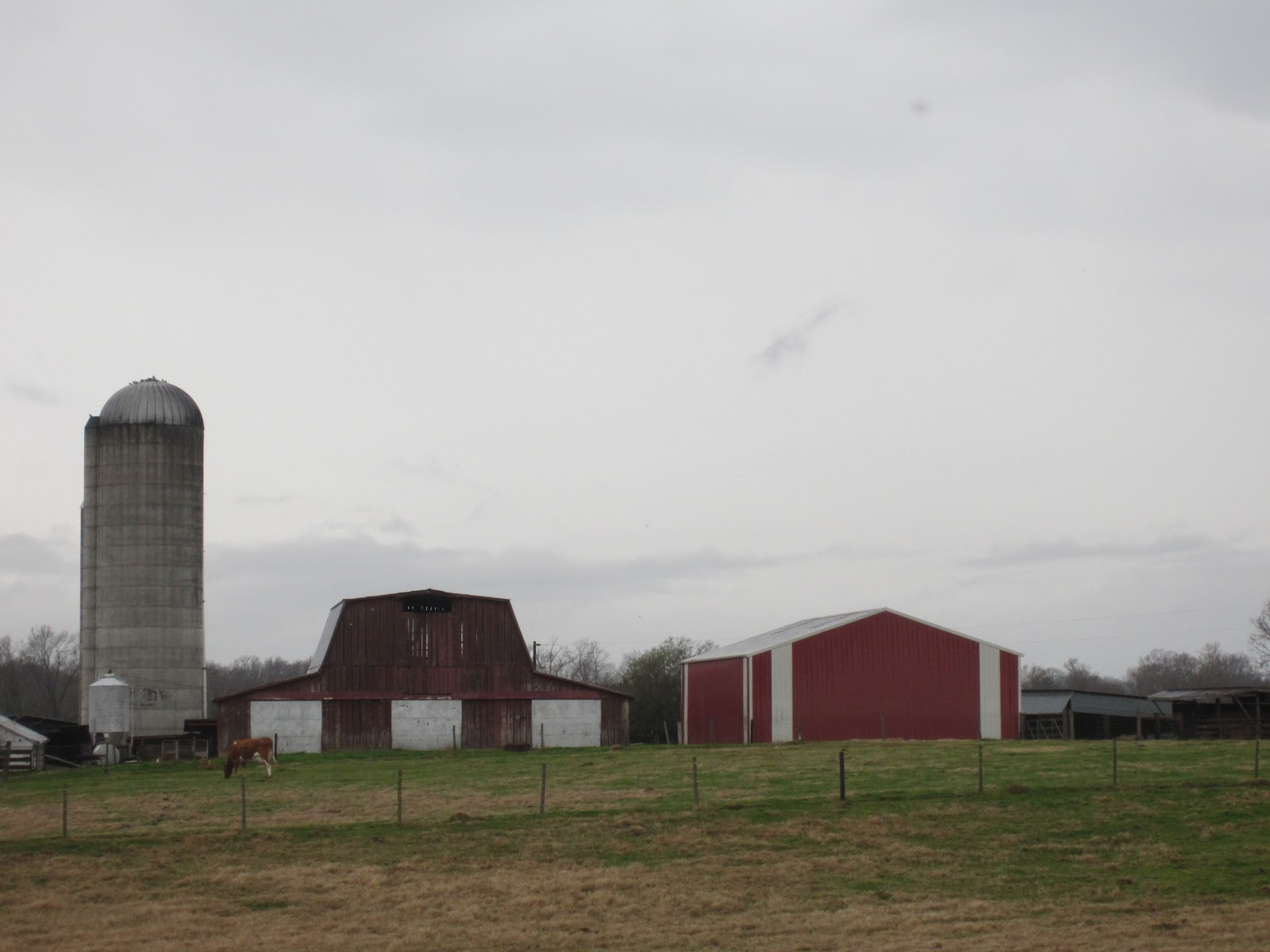 |
| Rural Tennessee is just an hour outside the city, |


I drove to the Ghost River and back before heading to the airport. The trajectory from Ghost River to the Mississippi via Wolf River will be the heart of my plan for the Fish Story events in May for Memphis Social.
Thursday, December 13, 2012
Day 1 December 13, 2012 Memphis, TN for Fish Story
 |
| Across the Mississippi |
 |
| View towards Mud Island on the Wolf River with hardscaped banks |
 |
| My shiny rental car |
 |
| Mother oak tree |
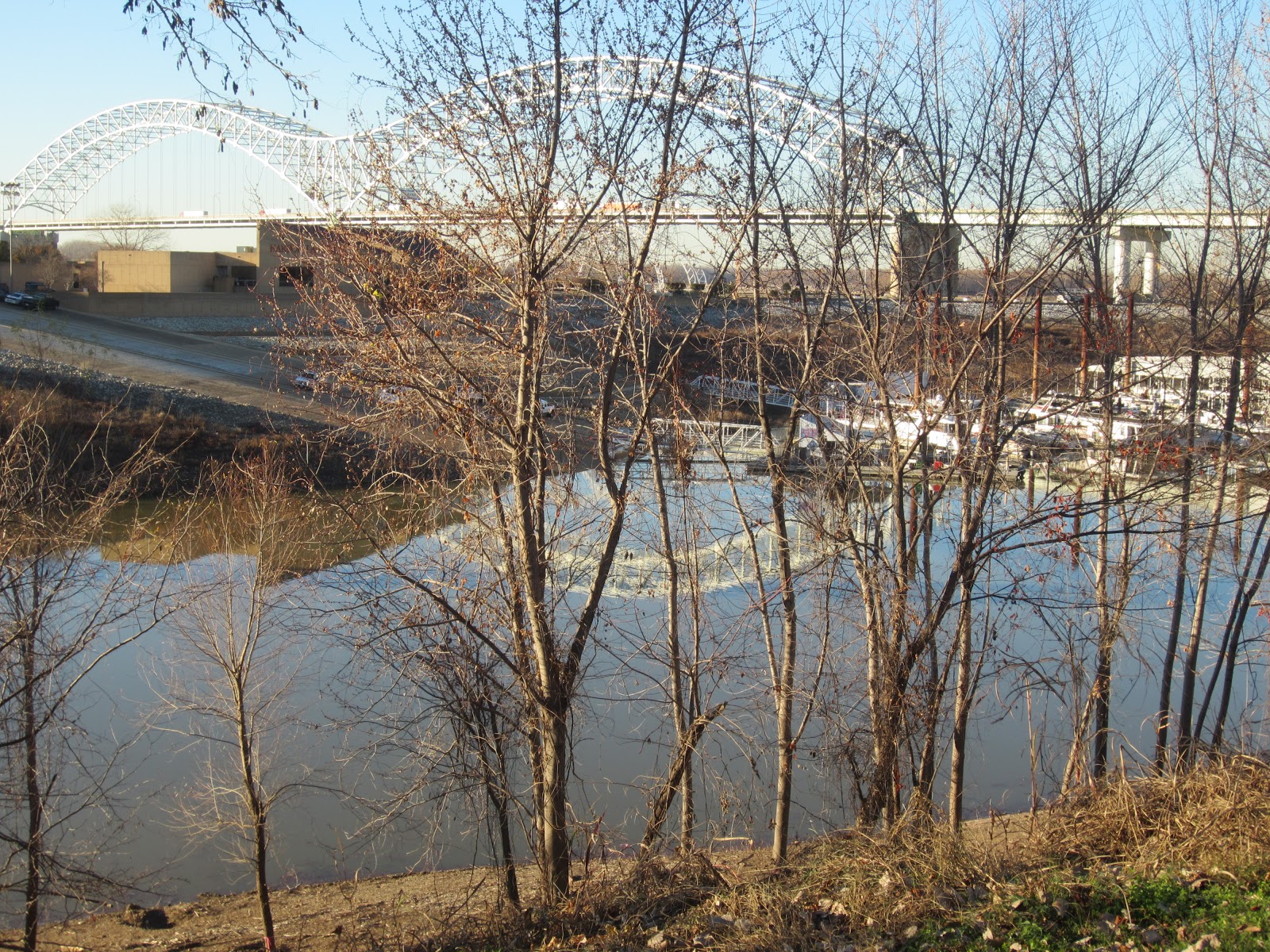 |
| Wolf River and bridge to another state |
 |
| Aborted baby oak trees |
 |
| A yellow lab was sleep on the driver's seat |
 |
| Resident squirrel at Welcome Center |
 |
| Unattributed sculpture of a c. 19 black man rescuing 35 white men from drowning |
 |
| Lunch at Stone Soup |
 |
| Compromise between softscaping and hardscaping the River banks |
 |
| Sunset light on the Mississippi |
Subscribe to:
Posts (Atom)