Showing posts with label fracking. Show all posts

Saturday, April 18, 2015

Considering paradoxes

There is a new debate about having children, questioning the motives of those who choose not to have children and judging them as selfish. However, when we consider the scale of the human population explosion against the dwindling lives of other species and the impacts on weather and climate for all living beings, I have to question the logic of those judgements.

It is a paradox, however, that humans experience their own personal drive to have a child as somehow exempt from the planetary consequences of billions of humans with similar drives.

Recently, my attention has been focused on another paradox, that many who staunchly oppose fracking, are cheerleaders for natural gas. It is a similar disconnect between wishful thinking and logical consequences.

In the sketch below from my journals, I have contemplated the paradox of how North America plans to deliver energy to a burgeoning and demanding population, while, incidentally crisscrossing the continent with fracking wells, pipelines that could explode, right thru the third largest watershed in the world. Earth Day, Tuesday afternoon, April 22nd, in discussion with Jim White and Gene Turner, we will discuss those disconnects in a Gulf to Gulf webcast.

The yellow horizontal she across the United States indicates the swath of fracking and natural gas destroying watersheds and habitats in its wake.


Monday, September 22, 2014

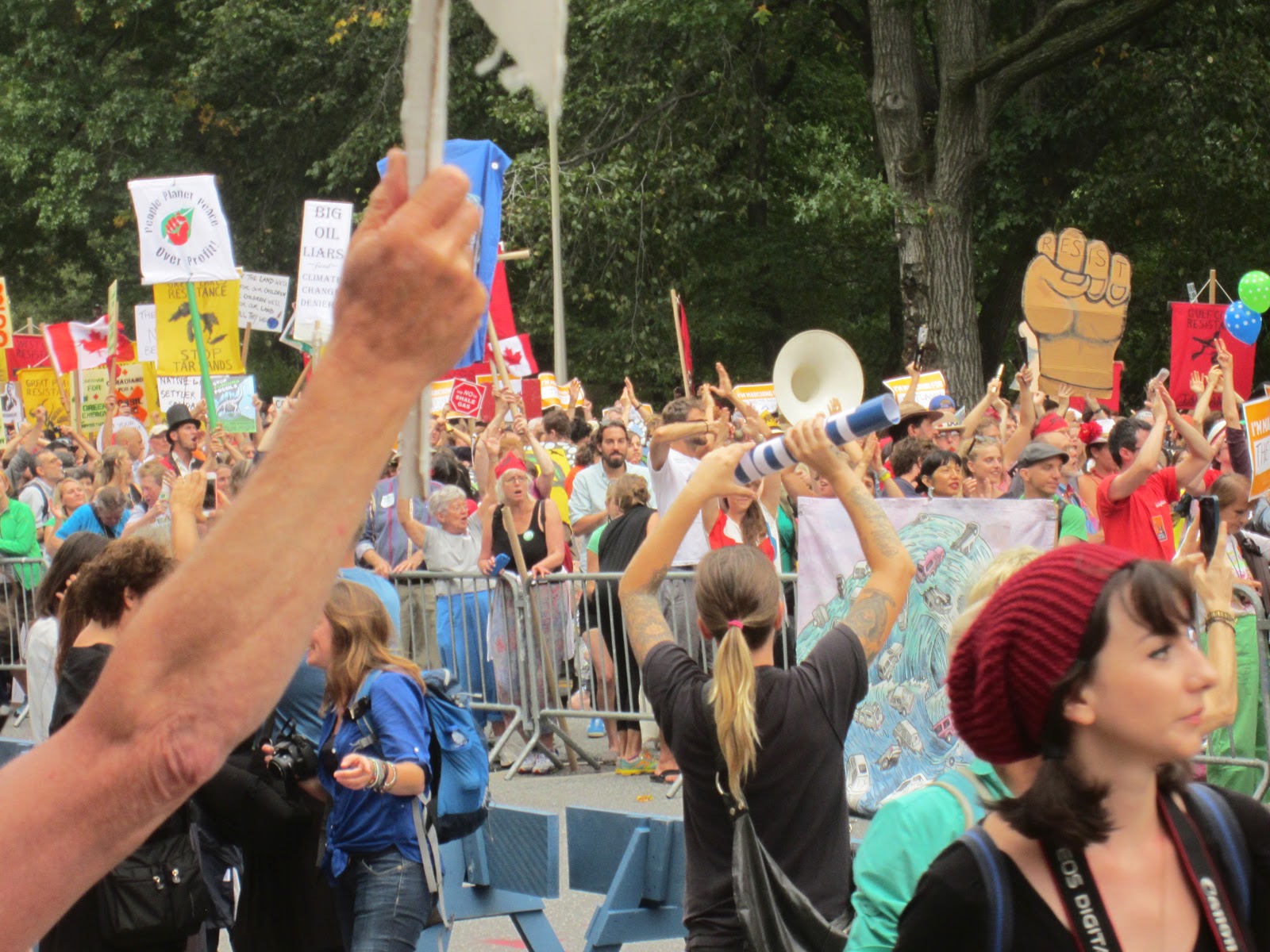
And so it begins. Post climate march thinking.

Chris Hedges,"we will have to act …(at the) beginning of a titanic clash," 'between the corporate government (inc the Democratic Party) and the will of the people to resist ecocide with civil disobedience.' Bernie Sanders, 'nothing happens in Congress without the approval of the fossil fuel industries … (the small evil group headed by the Koch brothers).' Arrests anticipated as the Flood Wall St. group heads towards the Koch Bros offices. Signage yesterday, "we know who is responsible." All yesterday I found myself off & on singing the Marseillaise, "allons infants de la Patrie, le jour de gloire at arrives." And as I said in one of my first trigger point workshops, on fracking in 2010, and I heard Bill McKibben reiterate this weekend, "there are more of us than there are of them." And so it begins.

http://en.wikipedia.org/wiki/La_Marseillaise
http://www.youtube.com/watch?v=221UWotqwdo


Saturday, May 11, 2013

Connecting the river dots in Fish Story

Today at 2:PM CT from the Memphis College of Art, we will do a public webcast to compare river issues in Memphis, TN from Fish Story, to river issues in Greece with Yvonne Senouf of MELD and Amy Lipton from ecoartspace and relate those problems to the emerging impacts of radioactivity with Eve Andre Laramme and radon from fracking with Ruth Hardinger.

Installation detail from the Hyde Gallery, Memphis College of Art, Memphis, TN
On a pedestal outside the installation room a hand-out says:

"Scientists have confirmed that carbon dioxide levels in the air have reached 400 parts per million.
(see article) Off-setting that rise would require people to green the earth by an additional 36% by 2030.  Without such drastic measures, most species, including humans will not survive. The easiest way to change that is to restore degraded ecosystems. Everyone on this earth can participate in that work. Memphis may be a critical place to begin.

    We emit globally about 10 BMT/yr of  carbon (billion metric tons per year) in Fossil Fuel burning       and deforestation. In 20 years, that would mean about 200 BMTs.There are about 550 BMT of carbon in all plants above ground, and 1,500 BMT below ground (in soil carbon), so you need to add   about 2% to the living global biosphere every year to offset the above. In 20 years that would mean you need to add 36% to the living biosphere to offset Fossil Fuels and deforestation, or you'd need 1/3rd more biosphere in 2030 to do the offset. Its less if you can figure out a way to speed up the transfer of carbon form the living bits to the soil carbon pool. 
–Dr. James White, member of the Fish Story team

Fish Story Memphis is about how the causes and effects of global warming are affecting fish as indicator species for habitat and water quality. Memphis is a critical ecoregion: in the third largest watershed in the world, along the sixth largest river, South of factory farms and North of dead zones in the Gulf of Mexico. The Wolf River may be a bioregional opportunity to effect large landscape restoration. Reconnecting the Wolf River to the Mississippi may be the first step.


Wednesday, January 23, 2013

Anthropocene Game for Gasser Grunert Gallery, a preview for Fish Story


Anthropocene Game for Gasser Grunert Gallery
Fish Story, Memphis is the center of the world: a trigger point for change
I'm interested in redefining public art as personal accountability to bioregions and environmental justice. That work includes creating strategies that catalyze overlapping constituencies to effect ecosystem resilience in the anthropocene.

The idea for trigger points emerged from my decade long project restoring a coastal town dump in Maine, Ghost Nets. Early in the project, I was diagnosed with a severe case of Chronic Fatigue Syndrome and found that acupuncture was the only way to support my resilience. It inspired me develop a theory of ecoregional nucleation for environmental restoration: trigger point theory.

The Anthropocene Game, on Martin Luther King Day, was designed for Alyce Santoro’s Dialectic Revival series, part of her installation at Gasser Grunert Gallery, 524 W. 19th St. in Chelsea, NYC. It was the gallery's first event after the devastating impact of Sandy, which left 21’ of water in their building. The game was intended as an experiment, a test for trigger point theory and the second phase of what will be done for Fish Story at Crosstown Arts, May 6, 2013.

Monday night, I began by reading a brief statement, which was also distributed in hand-outs:

Photograph of me delivering game instructions to the audience by Julian Mock. Work by Alyce Santoro behind me.

Trigger Points after the storm;
 finding where bioregionalism and environmental justice meet

We are in the Anthropocene, the era when humans have come to dominate every aspect of life on earth. But no living species evolved to cope with this level of rapid change. We are experiencing what I call, a collapse of time. In 2010, we entered the fast phase of climate change. Sandy was a symptom of that change. Many respond to change with fight or flight. What we need is connection.
Talk alone doesn’t solve these challenges. Some knowledge comes from embodied experiences. Some comes from meditation. Some comes from our senses. And some comes from talking. Tonight I want to seek new knowledge.
I invite you to join me in a sequence of experiences before we talk. It will be a game, an experiment in finding the “unknown unknowns,” Trigger Points, where bioregionalism and environmental justice might converge.

The print-out also Quoted from Rumsfield about unknown unknowns:

Slate has compiled … the exact words of the defense secretary (Donald Rumsfield), as taken from the official transcripts on the Defense Department Web site:
The Unknown/
As we know/ There are known knowns./ There are things we know we know./ We also know/ There are known unknowns./ That is to say/ We know there are some things/ We do not know./ But there are also unknown unknowns,/ The ones we don't know/ We don't know.
—Feb. 12, 2002, Department of Defense news briefing

In parenthetical statements, I conflated racism, speciesism as forms of lack of compassion or ecosystemic prudency. I spoke to why we would experiment with the role of play in discovering imaginative solutions, as a means of uncovering unexpected solutions to intractable problems. The discussion focused on the imminent problem of fracking in New York State. At the end of the evening, I concluded that people have a tendency to allow their passionate commitments to specific solutions to become competitive rather than co-operative (which may be overcome by connections between constituencies). We went thru the sequences I had planned: an initial intro, a game exercize, a meditation with music. The game directed people to create teams, such as “money” or “poverty” and then physically (albeit gently), struggle with each other to dominate the center of the space. The game continued until people formed a composite team of "connectivity." When I called “stop,” people sat down, closed their eyes and listened as I sang Faure’s Au Bord de L’Eau with Alyce accompanying me on her flute. Then we had our discussion. My notes below, fleshed out with some literal quotes, are from the ensuing discussion but not in any particular order, nor intended to be complete:

Ruth Hardinger: info on fracking, write letters. “Fracking would pollute drinking water for New York State and New York City's upstate watershed with poisonous, naturally occurring and induced chemicals and those toxins could migrate to aquifers and surface water. If hydraulic fracturing for gas is approved in NYS a result could be that when Marcellus Shale gas is piped to NYC, carcinogenic radon would be emitted from kitchen and commercial gas stoves. In drinking water, it could bring radon levels 80% higher than EPA standards for end users. Write letters to and call politicians now!”
O'Kang Ruddock: what is fracking?  (I answered by explaining that it is the nickname for hydraulic fraturing of rock, to retrieve natural gas. It requires massive amounts of water, the injection of toxic chemicals that migrate horizontally for miles thru rock fissures into the watershed and despite marketing publicity generate even more carbon than other fossil fuels)
Ghana: didn't speak, will call her later
Klemens Gasser: use strategy for activism
Tanya Grunnert: art can't use strategy (except Haacke), education & getting info out, apathy of young people -(my comment: what do we mean by strategy? Strategy is a plan but also a military term which relates to my experience after COP15, of large fossil fuel corporations pouring $ into disinformation. Artists have prerogative of appropriating terminology)
Kevin: (we) went from play, fun to fear, anger, conflict (Note -my interpretation-: because going from Kumbaya platitudes to becoming specific is where people can disagree)
Tom MyGlynn- strategy/ no strategy no diff for artists, “artists exist in the actual, between the ideal and the real, and that an agonistic tactics, strategy, is less effective in the social communication of such fraught issues as fracking than a willed suspension of judgment between the either /or of political struggle. A" beyond good and evil" approach may seem immoral on the surface but might actually go deeper than circular political arguments allow. Humans dwell in the "actual". More often than not it is artists that enact this with their practice, which isn't necessarily pragmatic, but nevertheless exists (or is an invitation to exist) in an actualized present.”
Ellen Levy: desperation of poor rural landowners over fracking makes them vulnerable (my comment: weakness & dependency of humans on water & other species = strength of arguments against denial). 
Abigail Doan: from farming family- her area in turmoil. Spoke of need for trust. “(there)is an underlying sentiment of distrust based on the differences perhaps between local activism and concerns and efforts by so-called city dweller, i.e. New Yorkers. Many in the upstate communities feel that NYers are in an outrage over fracking as it will effect their water supply and urban lifestyle, rather than being outraged that this wave will also destroy farm communities in areas that have been experiencing economic hardship for years now. There is already a built in tension that often leads to mistrust, and makes it difficult at times to brings these groups together. If fracking did not directly effect New Yorkers in some manner (and only impacted the rural communities to date) the NY activists might not be as outraged by this issue. Obviously, this is not just a regional concern, but this is the sort of frayed discussion that I hear around dinner tables when visiting folks four hours north of NYC.” - Abigail
Jay McDonald: answer is a new religion (of the earth)
Alexis: friends & family involve with fracking, discouraging (my comment: artists may not be able to have direct impact but perhaps indirect impact)
Aviva: play as part of answer, to Klemens & Tanya: rebuilding = spiritual resilience; each of us responsible to create constituencies, overlap constituencies
Alyce: recycling & using less (my comment: deprivation may not work unless people see potential for pleasure). " at the end of the action led by Aviva during which individuals named social or environmental challenges or themes that they would like to see addressed, representatives from the various "teams"  (water, fracking, joy, interdependence, poverty, etc) seemed to come quickly to the conclusion that, as we say in the OCCUPY movement, "all our grievances are connected"...many of us found ourselves in a twister-like configuration of hand-holding, not able to choose one particular "side", but realizing that no problem or solution exists in isolation. Personally, my chosen theme/team last night was "independence/interdependence"...reduction of consumption (by the greatest users: ie: we citizens of the "developed world") came up as an example, one of many ways we can become more engaged and conscious members of communities and society at large (i referenced joseph beuys' maxim that "everyone is an artist"...by engaging personal creativity we become empowered, engaged citizens)... "recycling" is a part of this."
Julian Mock: didn't speak but had contributed sound checking and Rumsfields quotes of unknown unknowns
Wendy Osserman: “I was struck by how cooperative we strangers to each other were even though we were somewhat reluctant & not sure what we were doing; it gave me hope that because people have this social side, perhaps together we can get things done that seem so difficult (fighting fracking etc)”
red-haired woman: did not speak
Roger Denson did not speak
Tom (non-artist): artists have onus of communication, even iconic images (Alyce's comment: not just one image, one artist)
Kate Temple: Joy initiated as a team "joy" in the trigger point (Anthropocene) game.

Later, Ellen Levy added, "An embodied approach to ecological issues makes sense, and it is the reason that artworks have the capacity to be moving emotionally.  In the case of your game, one advantage was that it required no props.  It seemed to me that the interpretation was, of necessity, ambiguous.  For some, the feelings provoked elicited interrelatedness. For me, it also illustrated that differing stances/ideologies could not occupy the same space.  I think that the game is certainly worthwhile to pursue as a way to open up discussion. Perhaps using 2 or more such games in encounters with audiences would lead to the ability to more easily compare the respective merits of such hands-on approaches. (another example that readily comes to mind is Lillian Ball's ecological game of competition vs collaboration, which does require props.).

And yet, this problem Ellen identifies, of containing different stances/ ideologies, is precisely what we need to solve in order to effect adaptive change.

The next night, the difficulties of achieving "joy" with the conflicting stances/ideologies problems we face was framed by the stark reality that for some people, whatever can be understood, created or designed may be too late for the kinds of discrepancies in justice we must reconcile with ecoregions. After the last of the 4 Dialectic Revival events last night, I wrote about what I later encountered on FB. When I falter in my own convictions or stamina to find solutions, I think of the kind of experiences I had last night:

Walking East in bitter cold & occasional snow flurries from Chelsea after the last Dialectic Revival event @ Gasser Grunert Gallery, the first beggar approached me on 9th Ave about 9:30PM. He was hunched over and said, "it's so cold out here. Can you spare some change? I want to get some food." His voice sounded desperate to me. As I fished in my purse for a dollar, thinking that wouldn't be enuf for a meal, he kept moving towards me as tho I embodied the hot dinner he needed. As soon as I could give him the dollar & wish him well, he was off asking the next person, still hunched against the cold. At 8th Ave I encountered the second beggar. He was seated on the pavement in front of a cardboard sign that said simply, "Homeless. Please help. God bless you." I can't imagine how cold he must have been tonight sitting motionless on that concrete, hunched like the first man, but his face hidden under a hood. He never looked up as I wished him good luck. Every Winter there are a few homeless people who die of hypothermia. I have a friend who thinks beggars shouldn't be indulged and never gives them change. I wonder what my friend would have thought of those two shivering people tonight?

If we can't have compassion for and connect to the most vulnerable of our own species, how can we have compassion for and connect to all the other species dying because of our negligence, let alone compassion for the consequence for ourselves? Perhaps we can't. What I hope, is that with Fish Story, we may at least care about our dinner plate and from there, realize that compassion connects us to our own dependency on the rest of the world.

Sunday, December 16, 2012

Day 4, December 16, 2012 Preparation for Fish Story, Memphis, TN

The pictures I took on my last day in Memphis, preparing for May's "Memphis Social," were all about the trajectory of fish and water from one small tributary (the Ghost River) to the Mississippi, via the Wolf River. It is a path fraught with human infrastructural impediments to the free flow of clean water and that trajectory recapitulates many obstacles to either sustainability or resilience humans have instituted. Those obstacles often mitigate against our own survival and recapitulate questions about environmental justice and ecoregional linkage.

One of those obstacles is what may be contaminating the water. Most countries are now dealing with the "choice" between fracking for natural gas and the "environment," framed as choices about energy vs. water and air quality. But is energy all there is?

In TN, yesterday, where I spent most of the day researching for Fish Story, I drove thru healthy farmland. TN is not far from fracking activity in North Dakota. North Dakota is where TN water comes from and the TN dilemma is a paradigm for the rest of the world. Fracking is already an issue in Pennsylvania & an imminent issue for New York State. The UK is teetering on the brink of enormous decisions about fracking and much of Europe has taken sides on the controversy.

This recent article by Elizabeth Royte in The Nation, details the additional implications of potential impacts on food supplies: 

http://www.thenation.com/article/171504/fracking-our-food-supply#

I won't go into the insanity of trading not just water or wildlife but food for the short term energy "benefits" of "natural" gas. But consider: Royte writes of the tails dropping off of cattle and squirrels. There is currently no testing being done on animals and plants subjected to nearby fracking. We have no tails that might fall off when we consume our food. But as apex predators, the chances are that our bodies will concentrate even more toxins that will affect our systems.

In speaking with some of the Foundations in Memphis, Ducks Unlimited, a representative said, "we are moving as fast as we can slowly." The problem for us all, is that may not be fast enuf.

Royte's additional information speaks again, to the often difficult tension I, along with so many others, struggle to sustain, between urgency and calm reflection on challenging environmental issues. The advice from Royte was, ask your organic farmers, 'how close are you to fracking and have you tested your produce?' 


Approaching the Church of the River, which has prioritized good stewardship for its' location on the river.

The view from the Church of the River onto the Mississippi before the service, just past the point where the Wolf River historically emptied into The Big Muddy.

Singing Christmas carols at the Church of the River after the service.

The Rev. Burton D. Carey clowning with his congregation, as one of the lords a leapin' for the "12 Days of Christmas," at the Christmas carol sing-a-long at the Church of the River.

View of the Mississippi after the Church of the River service and caroling, 2 hours after I first arrived, with a subtle change in the light.

Band of erosion exposing the rich soil quality, down a country road near the beginning of the Ghost River that feeds the Wolf River, a tributary of the Mississippi.


At the end of the country road I drove down, it turned into a dirt private drive for what was apparently a large estate, possibly a former cotton plantation.


Once this countryside was part of King Cotton, the center of the economic world. Now, the remnants of field cotton look just like melting old snow, like another vanishing memory, the real snow of "real" winters, before global warming. The vast cotton industry was sustained with slavery, arguably, analogic to how the present world economy is sustained by fossil fuels including natural gas.


Rural Tennessee is just an hour outside the city,


I drove to the Ghost River and back before heading to the airport. The trajectory from Ghost River to the Mississippi via Wolf River will be the heart of my plan for the Fish Story events in May for Memphis Social.

Monday, December 10, 2012

The future is us

Tomorrow, I head to Memphis to begin on the site research and conversations for Fish Story. Meanwhile, I continue to edit my dissertation, with the expectation that I will be done in March. Each page edit is a drawing and another opportunity to consider how to model change in the face of uncertainty.

Page of edit notes from dissertation

In 2010 for the eartotheearth festival http://www.eartotheearth.org/ in NYC, I did one of a series of performance events on fracking, experimenting with how embodiment might be part of the solution. Now, I am coming to the end of my dissertation work and between working on my dissertation, am moving along on Fish Story. These have been experiments in how to model community solutions to climate change.

Memphis, TN., is my next trigger point research site. I am going to meet folks with whom I might work on Fish Story for May, to walk along the river banks there and think about how Memphis might be a trigger point at the center of the North American world: sited between the species loss, fires, droughts, floods, dead zones, factory farms and the Arctic opening of the grand anthropocene, where polar bears are going extinct. I will present a PPT about Fish Story in a Pecha Kucha @ Crosstown Arts http://crosstownarts.org/ in Memphis Thursday night and meet with people from Ducks Unlimited (DU) http://www.ducks.org/ Friday morning. I plan to sing in one of the local churches Sunday and get to Graceland before heading home. At DU, one of my interests will be to study their extensive GIS work.


Yesterday, Chandler Blackington, on Vinalhaven island, Me., where I'm a legal resident, posted in his town blog, that Governor LePage defunded climate change studies for the state. I wrote him, cc: to our town manager, "As far as the climate change issues you referenced and the Governor has abandoned, thank you! I think this is very serious stuff and foolish to ignore. A couple years ago (after COP15), I suggested we start a town committee to deal with how we might be affected, on the advice of NOAA, with whom I'd spoken in Copenhagen.  I offered to serve on that committee. In 1994, the town parking lot was flooded to the Post Office and waves broke under my studio. That scenario might be much worse next time. My proposal was voted down by the Town Selectmen as "not necessary." I sincerely hope this is taken up again and would still be happy to serve. I think it is VERY NECESSARY prudence, even more so than in 2010 because we are now in the cumulative "fast phase" of climate change. I appreciate you bringing it up publically. It was my observation during COP15, that future needed change would not come from policy makers. It will come from people like yourself."

The future is us.

Since Dec 18, 2010, there have been some dark times on this planet. Yesterday, I participated in a  panel, "Culture trashes nature," at Sideshow Gallery http://www.sideshowgallery.com/, with Ruth Hardinger and Jonathan Goodman. One of our threads was about how you fight this environmental war (with unscrupulous corporations and the policy makers that support them) from a sane position of generosity and with the power of art? Not easy, eh? But as I stated last night, as I believed in 2010, and believe even more firmly now, an answer is in social networking and linked platforms: us.


Dec 18, I will be home and it will be exactly three years since I left the IPCC http://www.ipcc.ch/climate change United Nations Conference of the Parties (COP15) in Copenhagen. That was the day I wrote my last post for my blog at the time: High Tide COP15 project http://www.blogger.com/blogger.g?blogID=3532459556869820195#allposts. I posted after the Danish police attacked demonstrators, threatened participants at the Bella Center and closed the doors to official observers, including myself, leaving me shaken and angry.

Right after that, the fossil fuel corporate industries launched 2 devastating campaigns. One campaign was a blitz of disinformation to confuse the alerted public and lull them back to silence. The second campaign was to launch drilling for natural gas: fracking, which is endangering water supplies world wide. fracking would enrich those corporations at the future expense of all life on this planet. We need us to have a future ...  that's why I'm headed for Memphis.


Monday, November 12, 2012

Acts of God

Tropical Cyclone Storm Surge Probabilities, NOAA site
Chance of Storm Surge >= 2 feet (NGVD-1929) at individual locations
Sandy (2012) Advisory 31
For the 77 hours from 11 PM EDT Mon Oct 29 to 04 AM EDT Fri Nov 02

Unlike my academic writing for my dissertation, on this blog, I can own my opinions without too many citations. I have a few opinions about Hurricane Sandy.

Hurricane Sandy has turned many lives upside down in NYC, not to mention those lost but we have never so desperately needed to invert our ideas about our relationships to nature, from infinite expansionism and extraction to accepting our limits while exercizing infinite empathy. we used to say that major weather events were an Act of God. I charge that Hurricane Sandy was an act of stupid white men. Michael Moore's Stupid White Men were DC policy makers. I think we are all stupid white men when it comes to the environment. We have made a world where Cuomo and Bloomberg can talk about storms like Hurricane Sandy becoming routine. We have replaced god, with our own stupidity.

In considering my new project for Memphis, Fish Story, I am still thinking about fish: the fish that have now lived (if they still live) in a toxic soup of chemicals and sewage for almost two weeks (not to mention the birds that eat them or the small life the fish normally consume). In a "normal, healthy" estuarine system which historically surrounded Manhattan Island with fecund abundance, Sandy should be part of a cycle of high impact phenomena to bring even greater nourishment and support to this bioregion. Instead, we have made a charnel house of this region.

Humans, particularly white European colonists and their progeny since 1650, have ignored any attention to how things work in their own world, except as they serve short term interests of acquiring material wealth and power. New York City, is in fact the icon of exactly that acquisition. It has been enormously successful in proselytizing that ethos and exporting it globally out to the world. the consequence of all that "success" is this disaster. We expanded to the point of what Jared Diamond wrote of as Collapse, filling in the wetlands that might have protected us. What has collapsed is the fertile, protective natural system that protected us and the built infrastructure that replaced it. That collapse signals an opportunity to exchange and invert our priorities. To exchange expansionism for empathy for all life. If we live with empathy, we cannot countenance what we have done to this planet. If a god had any part in Hurricane Sandy, it was in the circumstantial conflation of a climate change event and the Apple, days before an election for president of the USA.

It has been incidental to the success of our great expansionist society, that NYC is also full of begging homeless people, extracted from a culture that has no place for them.

Drawing of homeless woman begging across the street from Bloomingdales, May (from Homeless in the Apple project) 2012 Aviva Rahmani
Now, we are talking about the impact of global warming. In my opinion, global warming is the symptom of a terrible spiritual disease that is literally killing the whole world. My opinion is that Hurricane Sandy, as part of global warming in the anthropocene, is a spiritual wake-up call. The spiritual part has little to do with gods in the world and everything to do with the moral power of empathy for what is not us. Hurricane Sandy was not an Act of God. It was the backdraft of many acts by many people who chose convenience, expedience and short term gain (including myself) over encompassing a view of the world which might include the suffering of others, whether fish or homeless women across the street from a luxury emporium. As I type, I am listening to Brian Lehrer on WNYC speaking to a caller from Coney Island, describing old people walking down 14 flights of stairs to deliver a bucket of their own waste to the street level. None of that misery is the consequence of an Act of God.

Tomorrow, I will record another Gulf to Gulf webcast to discuss the science behind this new normal reality in depth with Jim White, my collaborator from INSTAAR and will post the url after we are done. Friday evening, I will participate on a panel at LIU in Brooklyn about fracking and social media. I will also post further about that here before the event. They are connected: the fish, the homeless, the old people with a bucket of waste, fracking and the world crying for an ethos of empathy rather than expansionism. And it is here, on the net, where we can advance another point of view, one that might invert our present headlong trajectory towards destruction.