 |
| Side entrance to the Memphis, TN Brooks Museum of Art, where I met with Virginia McLean of http://www.friendsforourriverfront.org/ for almost three hours to discuss the Fish Story strategy. |

Sunday, December 16, 2012
Day 3 December 15, 2012 Preparation for Fish Story at Memphis, TN

Day 2 December 14, 2012 Memphis preparation for Fish Story
 |
| Shelby Farms, Memphis, TN |
 |
| Resident Buffalo herd for Shelby Farms, Memphis, TN |
 |
| Channelized stream at the entrance to Overton Park, Memphis, TN: 110 acres of old growth forest in the heart of the city. Shockingly, in the dead of night, the Memphis Zoo had cut 15 acres of the forest to make room for their own display. Shortly afterwards, citizens organized to protect what was left of the forest. |
 |
| One of several beautiful snag habitats left for local wildlife at Overtone Park |


 |
| No cathedral is more elegant. |
 |
| The beginning of sunset in Overton Park. |


Thursday, December 13, 2012
Day 1 December 13, 2012 Memphis, TN for Fish Story
 |
| Across the Mississippi |
 |
| View towards Mud Island on the Wolf River with hardscaped banks |
 |
| My shiny rental car |
 |
| Mother oak tree |
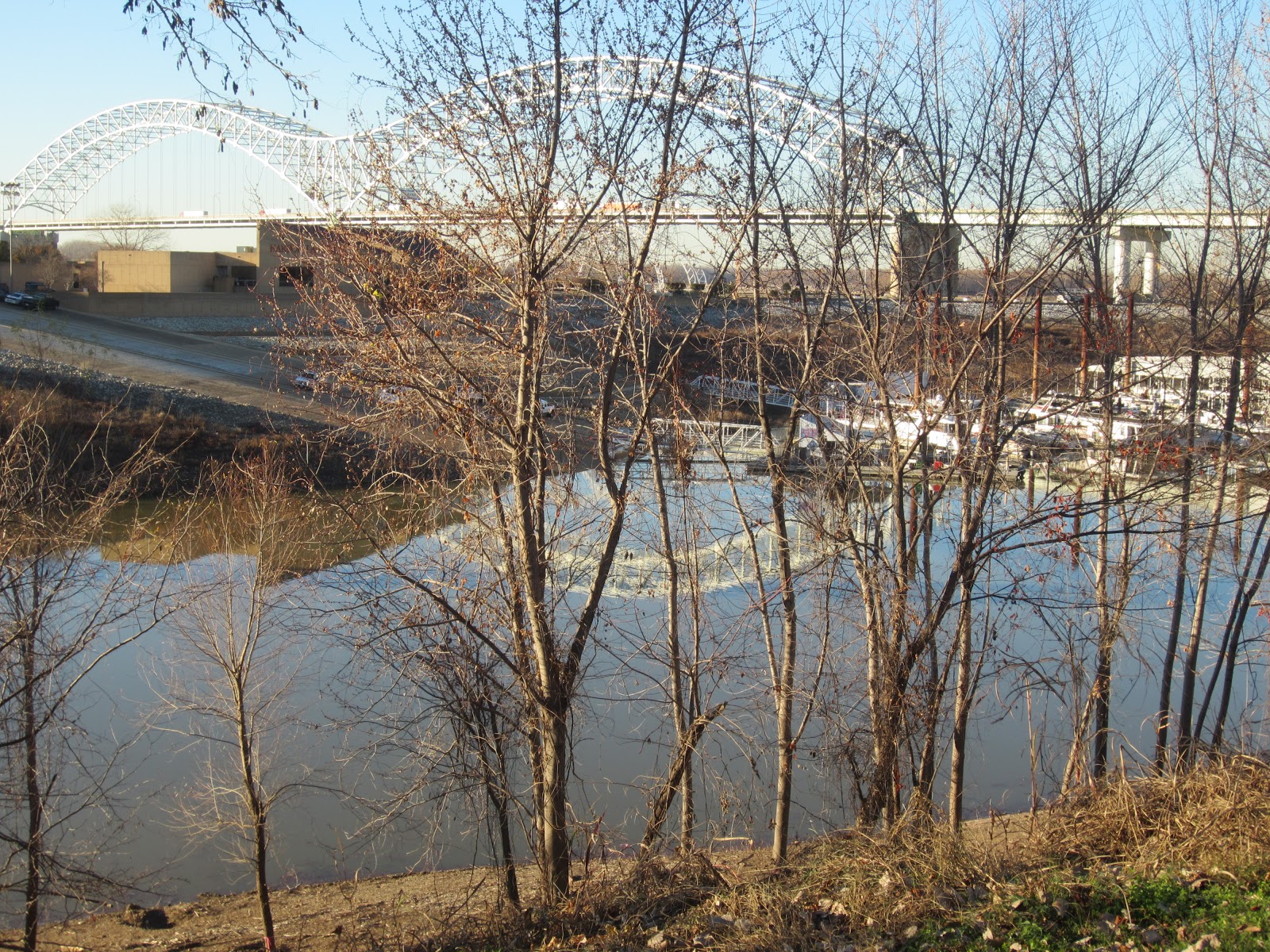 |
| Wolf River and bridge to another state |
 |
| Aborted baby oak trees |
 |
| A yellow lab was sleep on the driver's seat |
 |
| Resident squirrel at Welcome Center |
 |
| Unattributed sculpture of a c. 19 black man rescuing 35 white men from drowning |
 |
| Lunch at Stone Soup |
 |
| Compromise between softscaping and hardscaping the River banks |
 |
| Sunset light on the Mississippi |
Wednesday, December 12, 2012
I am in Memphis to give fish a break
I AM IN MEMPHIS.
This is why:
“… global warming is likely to spur
the disappearance of trout and salmon from as much as 18 to 38 percent of their
current habitat by the year 2090. (and) …habitat loss for individual species
could be as high as 17 percent by 2030, 34 percent by 2060 and 42 percent by
2090” http://www.nrdc.org/globalwarming/ntrout.asp
I'm staying at a quasi-commune church hostel community: PIlgrim House, where Flo, the young woman who greeted me, a student at Memphis College of Art, already knows all about Memphis Social for May, that I'm here for to start Fish Story and Crosstown Arts, where I'll present tomorrow evening. I asked Bradley, the young man who helped me get settled if people were concerned about climate change here. he said, "yes, quite." Good.
I have rehearsed my pitch: I am an ecological artist, part of a team with scientists to look at how communities can link up bioregional climate change issues, focusing on fish.
For Crosstown Arts, I assembled 20 slides for tomorrow night:
 |
| Using webcasts as leverage, workshops, GIS analysis and visuals, our goal is to help effect environmental restoration. We believe Memphis is at the center of the world of climate change in North America, at a crossroads. |
Monday, December 10, 2012
The future is us
Tomorrow, I head to Memphis to begin on the site research and conversations for Fish Story. Meanwhile, I continue to edit my dissertation, with the expectation that I will be done in March. Each page edit is a drawing and another opportunity to consider how to model change in the face of uncertainty.
In 2010 for the eartotheearth festival http://www.eartotheearth.org/ in NYC, I did one of a series of performance events on fracking, experimenting with how embodiment might be part of the solution. Now, I am coming to the end of my dissertation work and between working on my dissertation, am moving along on Fish Story. These have been experiments in how to model community solutions to climate change.
Memphis, TN., is my next trigger point research site. I am going to meet folks with whom I might work on Fish Story for May, to walk along the river banks there and think about how Memphis might be a trigger point at the center of the North American world: sited between the species loss, fires, droughts, floods, dead zones, factory farms and the Arctic opening of the grand anthropocene, where polar bears are going extinct. I will present a PPT about Fish Story in a Pecha Kucha @ Crosstown Arts http://crosstownarts.org/ in Memphis Thursday night and meet with people from Ducks Unlimited (DU) http://www.ducks.org/ Friday morning. I plan to sing in one of the local churches Sunday and get to Graceland before heading home. At DU, one of my interests will be to study their extensive GIS work.

Yesterday, Chandler Blackington, on Vinalhaven island, Me., where I'm a legal resident, posted in his town blog, that Governor LePage defunded climate change studies for the state. I wrote him, cc: to our town manager, "As far as the climate change issues you referenced and the Governor has abandoned, thank you! I think this is very serious stuff and foolish to ignore. A couple years ago (after COP15), I suggested we start a town committee to deal with how we might be affected, on the advice of NOAA, with whom I'd spoken in Copenhagen. I offered to serve on that committee. In 1994, the town parking lot was flooded to the Post Office and waves broke under my studio. That scenario might be much worse next time. My proposal was voted down by the Town Selectmen as "not necessary." I sincerely hope this is taken up again and would still be happy to serve. I think it is VERY NECESSARY prudence, even more so than in 2010 because we are now in the cumulative "fast phase" of climate change. I appreciate you bringing it up publically. It was my observation during COP15, that future needed change would not come from policy makers. It will come from people like yourself."
The future is us.
Since Dec 18, 2010, there have been some dark times on this planet. Yesterday, I participated in a panel, "Culture trashes nature," at Sideshow Gallery http://www.sideshowgallery.com/, with Ruth Hardinger and Jonathan Goodman. One of our threads was about how you fight this environmental war (with unscrupulous corporations and the policy makers that support them) from a sane position of generosity and with the power of art? Not easy, eh? But as I stated last night, as I believed in 2010, and believe even more firmly now, an answer is in social networking and linked platforms: us.
 |
| Page of edit notes from dissertation |
In 2010 for the eartotheearth festival http://www.eartotheearth.org/ in NYC, I did one of a series of performance events on fracking, experimenting with how embodiment might be part of the solution. Now, I am coming to the end of my dissertation work and between working on my dissertation, am moving along on Fish Story. These have been experiments in how to model community solutions to climate change.
Memphis, TN., is my next trigger point research site. I am going to meet folks with whom I might work on Fish Story for May, to walk along the river banks there and think about how Memphis might be a trigger point at the center of the North American world: sited between the species loss, fires, droughts, floods, dead zones, factory farms and the Arctic opening of the grand anthropocene, where polar bears are going extinct. I will present a PPT about Fish Story in a Pecha Kucha @ Crosstown Arts http://crosstownarts.org/ in Memphis Thursday night and meet with people from Ducks Unlimited (DU) http://www.ducks.org/ Friday morning. I plan to sing in one of the local churches Sunday and get to Graceland before heading home. At DU, one of my interests will be to study their extensive GIS work.

Yesterday, Chandler Blackington, on Vinalhaven island, Me., where I'm a legal resident, posted in his town blog, that Governor LePage defunded climate change studies for the state. I wrote him, cc: to our town manager, "As far as the climate change issues you referenced and the Governor has abandoned, thank you! I think this is very serious stuff and foolish to ignore. A couple years ago (after COP15), I suggested we start a town committee to deal with how we might be affected, on the advice of NOAA, with whom I'd spoken in Copenhagen. I offered to serve on that committee. In 1994, the town parking lot was flooded to the Post Office and waves broke under my studio. That scenario might be much worse next time. My proposal was voted down by the Town Selectmen as "not necessary." I sincerely hope this is taken up again and would still be happy to serve. I think it is VERY NECESSARY prudence, even more so than in 2010 because we are now in the cumulative "fast phase" of climate change. I appreciate you bringing it up publically. It was my observation during COP15, that future needed change would not come from policy makers. It will come from people like yourself."
The future is us.
Since Dec 18, 2010, there have been some dark times on this planet. Yesterday, I participated in a panel, "Culture trashes nature," at Sideshow Gallery http://www.sideshowgallery.com/, with Ruth Hardinger and Jonathan Goodman. One of our threads was about how you fight this environmental war (with unscrupulous corporations and the policy makers that support them) from a sane position of generosity and with the power of art? Not easy, eh? But as I stated last night, as I believed in 2010, and believe even more firmly now, an answer is in social networking and linked platforms: us.
Dec 18, I will be home and it will be exactly three years since I left the IPCC http://www.ipcc.ch/climate change United Nations Conference of the Parties (COP15) in Copenhagen. That was the day I wrote my last post for my blog at the time: High Tide COP15 project http://www.blogger.com/blogger.g?blogID=3532459556869820195#allposts. I posted after the Danish police attacked demonstrators, threatened participants at the Bella Center and closed the doors to official observers, including myself, leaving me shaken and angry.
Right after that, the fossil fuel corporate industries launched 2 devastating campaigns. One campaign was a blitz of disinformation to confuse the alerted public and lull them back to silence. The second campaign was to launch drilling for natural gas: fracking, which is endangering water supplies world wide. fracking would enrich those corporations at the future expense of all life on this planet. We need us to have a future ... that's why I'm headed for Memphis.
Thursday, November 29, 2012
On facing the anthropocene with resilient adaptive community evolution
We now know there isn't a corner of the earth that humans haven't impacted, not a force of nature our activities have left untouched. It is called the anthropocene. The anthropocene is our present geologic age dominated by humans. Speaking for myself, I don't think that dominance is a good thing. Speaking for myself, anthropocentrism, like racism, sexism and a few other isms, is not something I would wish on my worst enemy. It is a devastatingly short-sighted way to go thru life. The evidence is in the collapse of entire ecosystems we depend upon, the rise of what scientists call novel ecosystems, to replace those we've lost, often vastly over-simplified without enuf biodiverse redundancy to avoid even further collapse and even in their present state, often do not adequately service our own survival.
At the risk of sounding didactic, judgmental and exhortative, I think the answer, as Darwin pointed out a while back, may be moral evolution, a community affair. Meanwhile, back at the ranch, it often gets pretty scary to face the present and future we've created with our meddling. Fish, the subject of much of this blog and my new project (Fish Story), are the tip of the iceberg, the underwater, invisible canaries in our mines and so on.
But those of us who care about these issues are less and less alone. We are building communities and those communities are talking to each other. I have been a founding member and participant in one of those groups, the ecoart dialog, which numbers over 100 members internationally. It is an invitational list but of course there are many other groups with open membership. Recently, we have been corresponding about how dire the global situation is, sharing articles and thinking and how to cope with the anxious feelings that arise. Those feelings include, but aren't limited to: anger, fear, despair, confusion and grief.
The following is an edited version of what I posted this morning about facing the environmental crisis clear-eyed, but not alone. I am posting it here, with the full names of some of our members, to continue to enlarge the community of ecological art practitioners and thinkers and those who are our support and audience:
Speaking for myself, I really appreciate what others, inc Amy Lipton and this from you, Jan van Boeckel, have shared to give us all strength to continue, while squarely facing the realities here. Speaking for myself, one of the great values of this dialog is the opportunity, reinforced when we can meet in person, as we did this past Tuesday, at Jackie Brookner's or at each other's events, at conferences, etc, so there's a continuity of relationship.
At the risk of sounding didactic, judgmental and exhortative, I think the answer, as Darwin pointed out a while back, may be moral evolution, a community affair. Meanwhile, back at the ranch, it often gets pretty scary to face the present and future we've created with our meddling. Fish, the subject of much of this blog and my new project (Fish Story), are the tip of the iceberg, the underwater, invisible canaries in our mines and so on.
But those of us who care about these issues are less and less alone. We are building communities and those communities are talking to each other. I have been a founding member and participant in one of those groups, the ecoart dialog, which numbers over 100 members internationally. It is an invitational list but of course there are many other groups with open membership. Recently, we have been corresponding about how dire the global situation is, sharing articles and thinking and how to cope with the anxious feelings that arise. Those feelings include, but aren't limited to: anger, fear, despair, confusion and grief.
The following is an edited version of what I posted this morning about facing the environmental crisis clear-eyed, but not alone. I am posting it here, with the full names of some of our members, to continue to enlarge the community of ecological art practitioners and thinkers and those who are our support and audience:
Speaking for myself, I really appreciate what others, inc Amy Lipton and this from you, Jan van Boeckel, have shared to give us all strength to continue, while squarely facing the realities here. Speaking for myself, one of the great values of this dialog is the opportunity, reinforced when we can meet in person, as we did this past Tuesday, at Jackie Brookner's or at each other's events, at conferences, etc, so there's a continuity of relationship.
Speaking for myself, beyond abstract discussions, I need to know there's a caring, informed and experienced human heart on the other end of my dialogs with fear and anger. Not the same as therapy or even a partner.
Speaking for myself, it is all terrifying and enraging and yet, as Gene Turner quoted me as saying last year, human beings are very promising. We are smart creatures who can solve problems. And this is one h---- of a problem.
Recently, I inadvertently upset someone on the list, Linda Weintraub, when she realized I hadn't read her book before making comments about relativity and restoration. I do apologize for hurting anyone's feelings here on this list, inc Linda. I am passionate and some of that passion is fueled by intense frustration with the problems and the obstacles.
Thankfully, over the years, we have shared our values but have also overcome our disagreements because of a shared common, deep ecology ethic.
One of the issues that came up at Beverly Naidus's talk at Parsons last week, was the perennial one of urgency vs trying to bring the timid into the activist fold. As Beverly said Monday night, some people come in with a teaspoon. Most of us on this dialog come in with at least a shovel and sometimes, literally, an excavator.
These are things that personally scare me: that I won't have the stamina to continue (I still have chronic fatigue syndrome, I fear a recurrence of cancer or heart issues and all the potential economic issues around those problems), that even if I were superhuman, it wouldn't be enuf to forestall any of the coming disasters, let alone, the ones already upon us. I don't, curiously, fear being driven mad by the sheer scale of the problems. Perhaps, I am already over the edge.
These are the things I'm grateful for: that so many of us are reaching so many others, that so many of us share things (exhibitions, articles, essays, books, calls for conferences, etc), as Jan, everyone, has, that let me know or remind me how hard others are working on these problems, that we have genuine interest here in each other's work, a willingness to self-critique and honestly judge without meanness and are generally so often willing to share resources, ideas, opportunities that make it easier for us all to keep going.
This dialog began in 1998. As each of our careers have developed, it is remarkable how much we have clarified about our shared values, our common and divergent strategies, how much the field has expanded. It would be very interesting for someone to calculate, in fact, how many people we have collectively reached- if you add up all the conferences, students, exhibitions, articles, books, parties. Not inconsiderable.
You are all my teachers, as is everyone in my internet audience.
I am humbly grateful and fiercely proud: resilient adaptive evolution in practice here, I think.
Sunday, November 25, 2012
Thanksgiving labor
It is early Sunday morning and I am thinking about different kinds of work on a weekend when most of us take some time off. As I complete my dissertation writing and move forward with Fish Story, I can't help wondering how things will play out for my own life and everyone else. What I mean by play out, is how will we manage our resources in a changing world? Will we succeed in saving fish from all the ways we are transforming their waters? What about other familiar ingredients of our lives, like cranberries grown in wetlands for Thanksgiving?
I have had Chronic Fatigue Syndrome (CFS) since 1990, a mysterious immune system disorder which makes those of us who have it, very, very tired. Much more tired than most people can ever imagine. It seems to predispose us to cancer and among other symptoms, causes sleep disturbances, which is one reason I've been awake today since 3: AM thinking about work and sustainable systems. Lately, about that too, I find myself wondering how much resilience I can sustain. CFS has been an instructive illness because it means I have a built in template for how to live sustainably and accept the limits of my resilience. When I go past my limits, I collapse and whole swathes of my life fall apart. Applying the template is about what may happen to the earth as we go past our limits. For example, what may happen to the wetlands where we grow cranberries, if they become inundated with sea water from sea level rise with global warming? Speaking for myself and my built in template, my personal question is what part of the aspects of life I value, such as having all the right ingredients (cranberries, honey, etc) for making my cranberry sauce recipe for Thanksgiving will be resilient?
Last Thursday, I went to my sister, Ilana's house in Armonk, to make cranberry sauce for a family dinner at my nephew's house in Thornwood. My recipe takes about two hours and starts with Ruby's Dow Porto, which gets cooked down (never boiled) from two bottles with the juice of about nine oranges and their zest, light honey, maple and brown rice syrups and spices to a thick enuf consistency to make the texture, fragrance and taste divine. This is old-fashioned cooking. Will the ingredients, such as light honey made by honeybees still be here through out my lifetime?
I put my colleague and friend, Juliette Yuan, the New Media curator to work helping and she cheerfully grated the zest off the nine oranges before squeezing the juice out for the sauce.
On the way home, I encountered a musician in the subway who had gathered a crowd and was exhorting them to get moving in response to his labor. Will we still have subways under Manhattan?
I got home before midnight and woke the next day to complete most of the second chapter of my dissertation. My dissertation was inspired by the acupuncture treatments I take for CFS. I thought, if we can leverage small catalyst systems in the human body, can we do the same for the planet? I push myself now to complete writing up my research, because I want to think that some insight I may share will help the fish, the cranberries, myself find a measure of resilience.
Yesterday, I began writing my third chapter, about how Geographic Information Systems (GIS) science may take a point of landscape nucleation and extrapolate a useful analysis. I studied GIS at Lehman College for two years but I am not very good at it. GIS makes beautiful maps of complex relationships between systems, seductive blend of science and art. Perhaps, because it requires a high level of resilient physical stamina to sit at the computer and concentrate that is not very sustainable for me with CFS, I find it a very difficult media. So now I need to decide how far I will go to present my premises with this tool. Answering that question is a search for the right balance between personal resilience and understanding and communicating planetary resilience. In my last "Gulf to Gulf," webcast with Dr. Jim White, we spoke about sustaining the tension of that balance for climate change scientists: what are the personal limits for those who have been the messengers of global warming as they encounter a culture determined to silence truth?
I wrote on FB:
 |
| Simmering down Porto for cranberry sauce |
I put my colleague and friend, Juliette Yuan, the New Media curator to work helping and she cheerfully grated the zest off the nine oranges before squeezing the juice out for the sauce.
 |
| New Media curator Juliette Yuan grating zest with my brother-in-law as audience on Thanksgiving Day. |
 |
| Times Square musician |
I got home before midnight and woke the next day to complete most of the second chapter of my dissertation. My dissertation was inspired by the acupuncture treatments I take for CFS. I thought, if we can leverage small catalyst systems in the human body, can we do the same for the planet? I push myself now to complete writing up my research, because I want to think that some insight I may share will help the fish, the cranberries, myself find a measure of resilience.
Yesterday, I began writing my third chapter, about how Geographic Information Systems (GIS) science may take a point of landscape nucleation and extrapolate a useful analysis. I studied GIS at Lehman College for two years but I am not very good at it. GIS makes beautiful maps of complex relationships between systems, seductive blend of science and art. Perhaps, because it requires a high level of resilient physical stamina to sit at the computer and concentrate that is not very sustainable for me with CFS, I find it a very difficult media. So now I need to decide how far I will go to present my premises with this tool. Answering that question is a search for the right balance between personal resilience and understanding and communicating planetary resilience. In my last "Gulf to Gulf," webcast with Dr. Jim White, we spoke about sustaining the tension of that balance for climate change scientists: what are the personal limits for those who have been the messengers of global warming as they encounter a culture determined to silence truth?
I wrote on FB:
I have recovered most of the dissertation chapter I lost Tuesday night, reduced my word count from 18 009 to 10 695 and am almost done with my conclusion for this chapter, which begins with, "Scientists agree that problems of novel ecosystems, loss of water quality and quantity and trophic cascades are among the consequences of habitat degradation, encroachment and fragmentation, all caused by human agency serving anthropocentric attitudes. This chapter considered nucleation practices as part of a focus on how and when environmental restoration practice can shift a point of view, to conserve bioregional clean water and the role of animals in that process." And a good night to you all.
- And then yesterday, in reply to a link from Ann Rosenthal, I added that:
One of my points, about nucleation, is about how critical animals are to the health of the entire ecosystem that protects water. Each species distributes seeds, etc in specific patterns. Ie, bats & birds have very diff patterns. I have to focus on marine (littoral zones) in my research but there's a ton of fascinating data about forests, most of which I had to cut down to stay in the word limit. Of course, it all works a bit differently in the ocean, where tiny organisms, like detritovores carry out functions large carnivores fulfill on land, with tidal patterns functioning as wind does. Some of my third chapter is about mapping those relationships.
Today, in the NYTimes, there was an article about how much of New York City may end up underwater, possibly within our lifetimes. http://www.nytimes.com/2012/11/25/opinion/sunday/is-this-the-end.html?nl=todaysheadlines&emc=edit_th_20121125
Subscribe to:
Posts (Atom)